A list of cron tasks says when each should run. It does not say which two collide, which one has silently stopped, or which five start on the same minute of every hour. The horizon does.
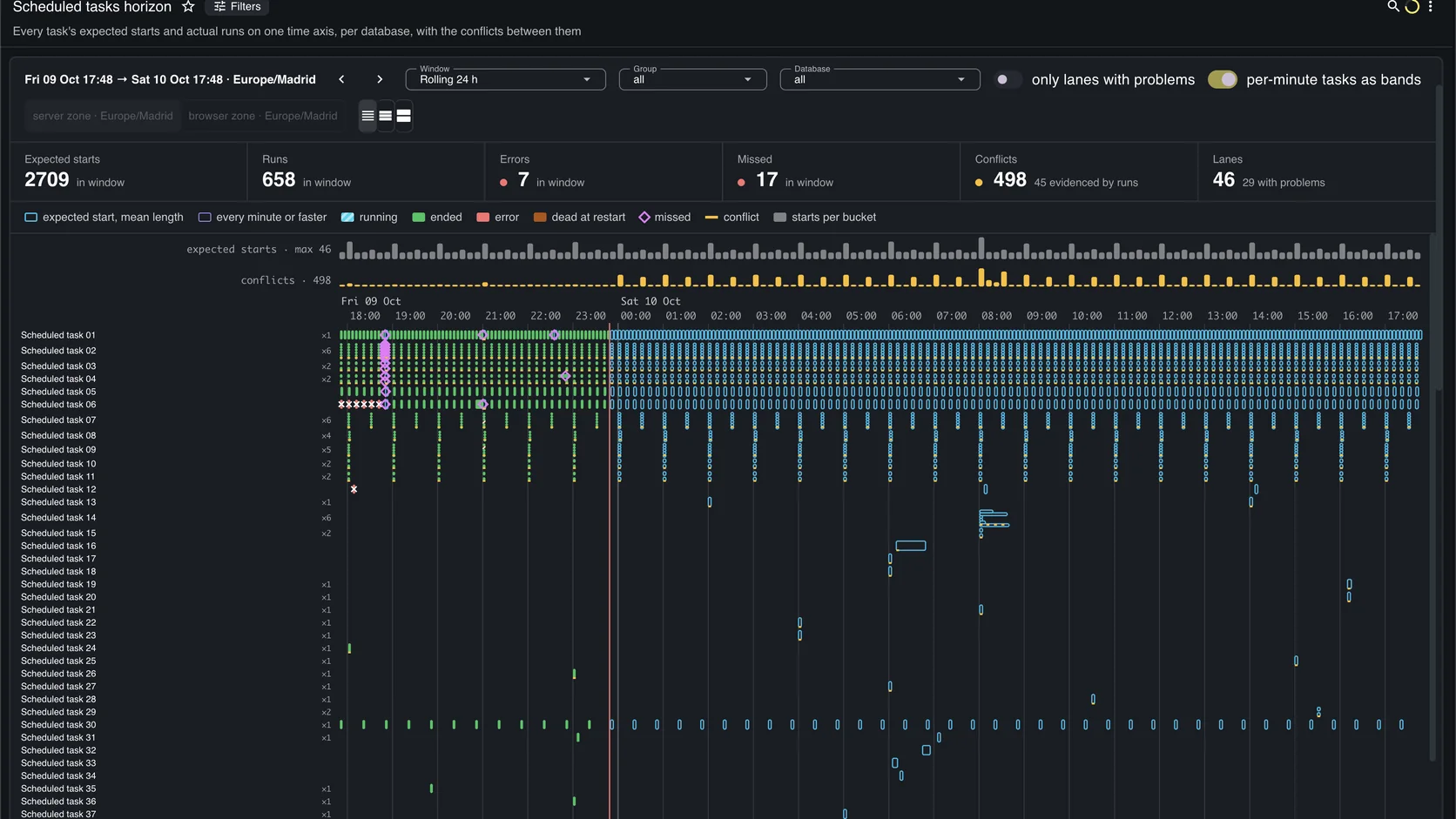
Drawn and assessed
- Lanes on one axis Each task's predicted fires and logged runs in a lane, per host, labelled in the zone the node fires in.
- Thirteen rules Overrun, error rate, dead restarts, silence, start latency, duration drift, never fires, daemon overruns, duplicates, hour clusters, peak concurrency, runtime share and the daemon's own state. Each finding carries a severity, a message, an action and a metric, and is computed once on the server so a page, the home, an MCP tool and a nightly report read the same rows.
- A grade per host, from A with no finding to E with three critical ones. A lane links its logs even when a finding has no single log.
What only the daemon knows
- Exposed to scripts Next fire, a run in progress, runs, errors, skipped fires and threads, per task. When a run ends past its next fire the daemon skips that fire and starts the next at once, and no log row records the skip.
- One expression The seven stored time fields are assembled into the cron expression in one method the daemon and the predictor both call, so what is drawn is what runs. A task that leaves its second unspecified gets a stable second derived from its identity, after a night when every such task fired on the same second and burst the bootstrap pool.
Scripts get the same assembler and a window query for every fire between two instants, capped so a per-second expression cannot become millions of dates.