Eight authentication mechanisms, multi-tenant by construction, audit by default.
A unified dynamic dispatcher routing to eight authentication mechanisms — HTTP Basic, Digest, Form + 2FA, JWT, OAuth 2.0, OpenID Connect, SAML 2.0 and mTLS. Multi-tenancy enforced through scoped per-request context at the runtime level. Row and column security injected into every query. Audit is a property of every write, not a feature added on top.
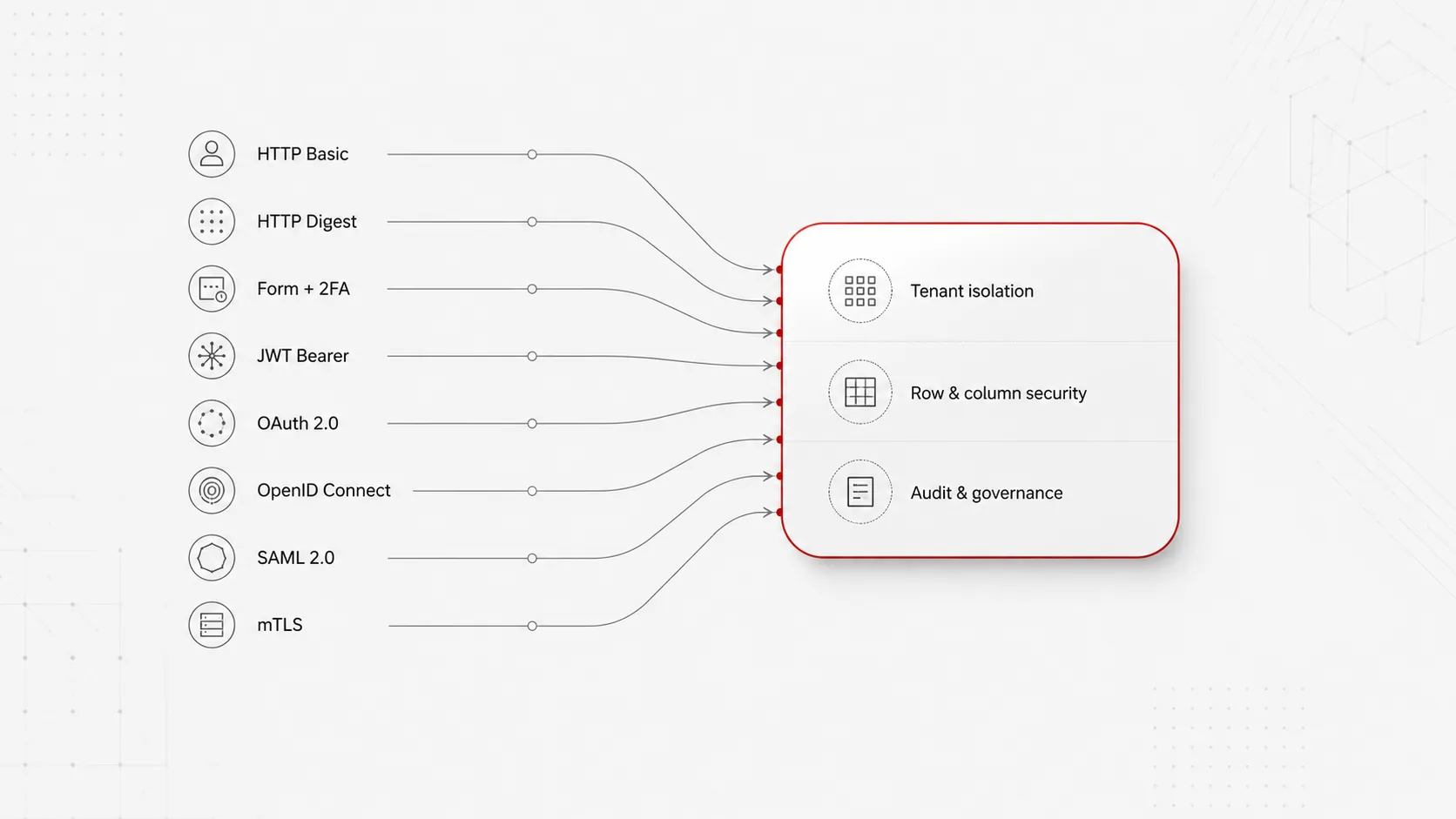
Eight mechanisms, one perimeter
HTTP Basic, Digest, Form + 2FA (TOTP / Email / SMS), JWT, OAuth 2.0, OpenID Connect, SAML 2.0, mTLS — unified under a single dynamic dispatcher. Mix LDAP, SSO and certificates inside a single installation.
Multi-tenant by construction
The runtime binds the authenticated principal and the target database to the request via scoped values (JEP 446). Applications cannot bypass tenant scoping; the runtime enforces it.
Row and column security injected by the compiler
The query compiler — not the application, not any AI agent that authored the query — injects tenant-scoping WHERE clauses, row-level expressions and column-level visibility rules into every generated SQL statement. Security is a property of the compilation, not a discipline the application has to remember.
Audit is a property of every write
Every transaction, master-data change and approval is recorded with timestamp, user identity, source document and prior-value history. The audit trail is the record, not a log of it.
Eight authentication mechanisms
Dispatched per request by a single dynamic authenticator. Same installation can authenticate users from LDAP, OAuth, SAML and client certificates concurrently.
HTTP Basic
Base64-encoded credentials over TLS. For service-to-service integrations where token lifecycle is unnecessary.
HTTP Digest
Challenge-response authentication; credentials never transmitted in plaintext.
Form + 2FA
Browser-form login with TOTP (RFC 6238), email OTP, SMS OTP or CAPTCHA. The default for interactive users.
JWT Bearer
Stateless signed-token validation. Signature, claims and expiry verified per request. Per-user revocation salt for instant invalidation.
OAuth 2.0
Authorisation-code flow, token introspection, refresh tokens. Integrates with enterprise identity providers.
OpenID Connect
OIDC discovery, ID-token validation, userinfo endpoint, claim mapping to platform principals.
SAML 2.0
SP-initiated SSO, assertion parsing, signature verification. The standard for enterprise federation.
mTLS
X.509 client certificates with DN-to-principal mapping. For service-to-service trust in regulated environments.
Identity, tokens and keys — hardened by default
The controls a security review asks for by name, as the platform ships them.
OAuth 2.1 with mandatory PKCE
Authorisation requests that omit the challenge are rejected. Client credentials serve machine clients ; refresh tokens are single-use. The same flow admits an AI agent to the MCP server, with a token minted for one endpoint that opens no other.
OpenID Connect discovery
A standard discovery endpoint for identity providers ; every token outcome, issued or refused, is logged.
JWT hardening
Token identifiers can be invalidated individually ; a database allow-list travels in the claim ; signing keys rotate with zero downtime and several keys valid at once. The blast radius of a leaked token is a table update.
Password posture
Argon2id hashing. Every password change is checked against known breach corpora without the password leaving the platform. Policy per department ; blocking, unblocking, password and two-factor resets are each a separate, recorded administrative act.
Startup refuses weak keys
RSA key length and JWT signing-key strength are enforced before the platform starts serving. A weak key is a refusal to boot, not a warning in a log.
Deploy is a permission
Changes to authentication configuration require a deploy flag on the acting user ; security-relevant changes send audit notifications by e-mail.
The key vault
Certificates, SSH key pairs and password secrets are held centrally. Destructive and administrative actions are restricted to an entry's owner and its managers ; adding or removing a secret is its own audited action. Server-side scripts retrieve a secret at run time and never see key material in code.
Verified drivers, restricted origins
Database drivers are provisioned centrally, verified by checksum on every load and never fetched at run time. IP and CIDR rules restrict where a company's users may come from, per path — standard login, REST API, administration, workbench — and a rule that would lock the administrator out is refused unless the lockout is meant.
Security is injected into the SQL, not added by the app
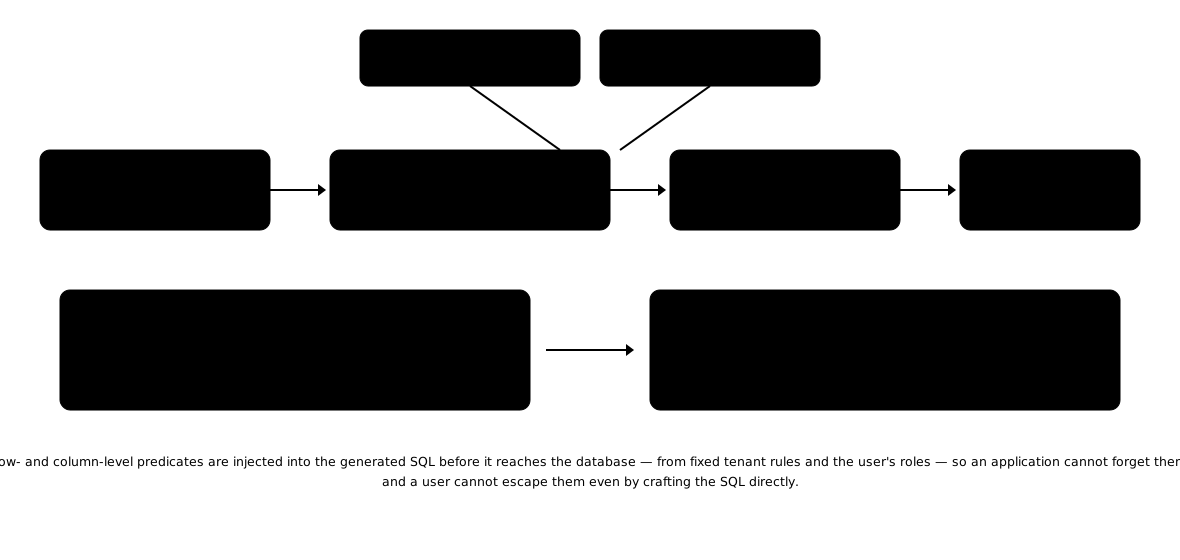
Multi-tenancy and access control
Tenant isolation is a property of the runtime, not a discipline applied by application developers.
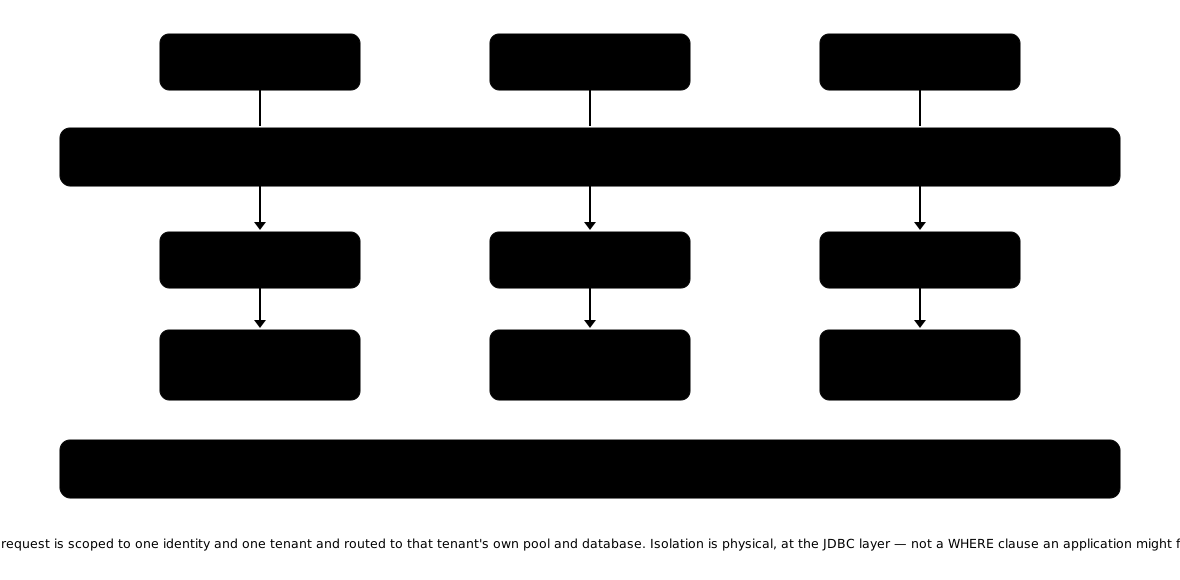
Scoped per-request context
Every request runs inside a scoped context that binds the authenticated principal, the target database and the tenant identity. Scoped values (JEP 446) make it impossible for application code to read out-of-scope context.
Per-tenant database routing
The bound database in the request context determines which JDBC pool, which engine and which replica the request hits. Tenants share infrastructure; they never share data.
Row-level security — injected by the compiler
Per-object SQL expressions injected by the platform's query compiler into every SELECT. Roles, departments and ownership rules are enforced at the data tier — not by application code, not by any AI agent that authored the query, not by any layer that could be bypassed. The security expression is a property of the user's runtime context; the compiler resolves it into the WHERE clause every time.
Column-level security — injected by the compiler
Field-level visibility rules per role, applied during query compilation. Sensitive columns are not just hidden from the UI — they are removed from the generated SELECT for users not entitled to read them. The data never leaves the database for users without entitlement.
Roles — additive, explicit, enforced before the handler
A user holds exactly the roles granted, directly or through the department ; a new capability is absent from every existing role until it is granted. Role enforcement is applied at the endpoint before the handler runs ; in-handler checks cover data-dependent rules. Seven role families apply inside an application once a grant opens a database — which objects open, when execution is locked, the row conditions spliced into every query, the table verbs, column defaults, the REST endpoints a user may call, and cube access.
Audit by default
Every write is recorded with full context — user, timestamp, IP, mechanism, source document, prior-value history. A separate audit channel records authentication events independently of the data-write log.
One installation, many tenants, isolated at the JDBC layer
Defence in depth, applied per layer
Security on the platform is not a single feature. It is a chain of guarantees applied at each layer the request passes through — TLS at the network edge, IP rules at the perimeter, OWASP filter at the HTTP layer, the eight-mechanism authenticator at the application edge, scoped tenant context in the runtime, row and column security at the SQL layer, mandatory audit at the persistence layer. Each layer makes assumptions about the layer below; none of them trust the application above.
The result is a posture where misbehaving application logic cannot leak data, cannot impersonate another tenant, cannot bypass rate limits and cannot escape the audit trail. The application's job is to express business logic; the platform's job is to enforce that the logic operates inside the rules.
The same architectural property covers AI agents. Agents on the platform generate XDBL (the platform's XSD-described query grammar), not raw SQL; the compiler emits engine-native SQL with row-level and column-level security injected per the user's runtime context. The agent does not connect to the database; the compilation step sits between the agent and the data. See platform/ai-mcp.html for the full chain.
What CISOs and security architects ask first.
Which authentication mechanisms are supported, and can we mix them in one installation?
Eight mechanisms — HTTP Basic, HTTP Digest, Form + 2FA (TOTP / Email OTP / SMS OTP / CAPTCHA), JWT Bearer, OAuth 2.0, OpenID Connect, SAML 2.0 and mTLS — unified under a single dynamic dispatcher that routes per request. A single installation can authenticate LDAP users for the back office, SAML for federated partners, OAuth for the customer portal and mTLS for service-to-service traffic concurrently. There is no requirement to standardise on one mechanism.
How is multi-tenant isolation enforced — at the application or at the runtime?
At the runtime, through scoped values (JEP 446) that bind the authenticated principal and the target database to the request. Applications cannot bypass tenant scoping because the runtime is what holds it ; the compilation step that turns metadata into engine-native SQL injects the tenant clause regardless of what the application asked for. Isolation is a property of the platform, not a discipline the application has to remember.
Where does row-level and column-level security live?
In the query compiler. The compiler — not the application, not any AI agent that authored the query — injects tenant-scoping WHERE clauses, row-level expressions and column-level visibility rules into every generated SQL statement. The same rule applies whether the query came from a generated screen, a server-side handler, an AI agent or an external MCP client. Security is a compilation step, not an application discipline.
What does the audit trail actually record, and how is it queried?
Every login, every REST call, every DML write, every approval, every AI invocation and every active session — captured with timestamp, user identity, source document and prior-value history. The audit trail is the record itself, not a log of it. Records are queryable as standard SQL through the platform's audit schemas alongside the rest of the application's data, so compliance teams use the same query surface engineers use.
How is offboarding handled — what happens when an account is revoked?
Offboarding is a single action that revokes database access, API access and active sessions in one step, propagated cluster-wide via Redis pub/sub. JWT tokens carry a per-user revocation salt so issued tokens invalidate immediately on revocation rather than at expiry. There is no "wait for the token to lapse" window after the account is closed.
Do AI agents and the MCP server respect the same security perimeter?
Yes — by construction. AI agents emit XDBL (the platform's XSD-described query grammar), not raw SQL ; the compiler emits engine-native SQL with row-level and column-level security injected per the user's runtime context. The agent does not connect to the database directly. The MCP server gates tool and resource access at the SPI level per caller role. The permission perimeter extends uniformly into autonomous agent interactions.