

AI-Native
AI Inside the Enterprise Runtime
Airtool integrates artificial intelligence directly into its execution architecture, operating within the same governed runtime as enterprise applications, enforcing role-based access control, data permissions, tenant isolation, audit policies, and usage accounting.
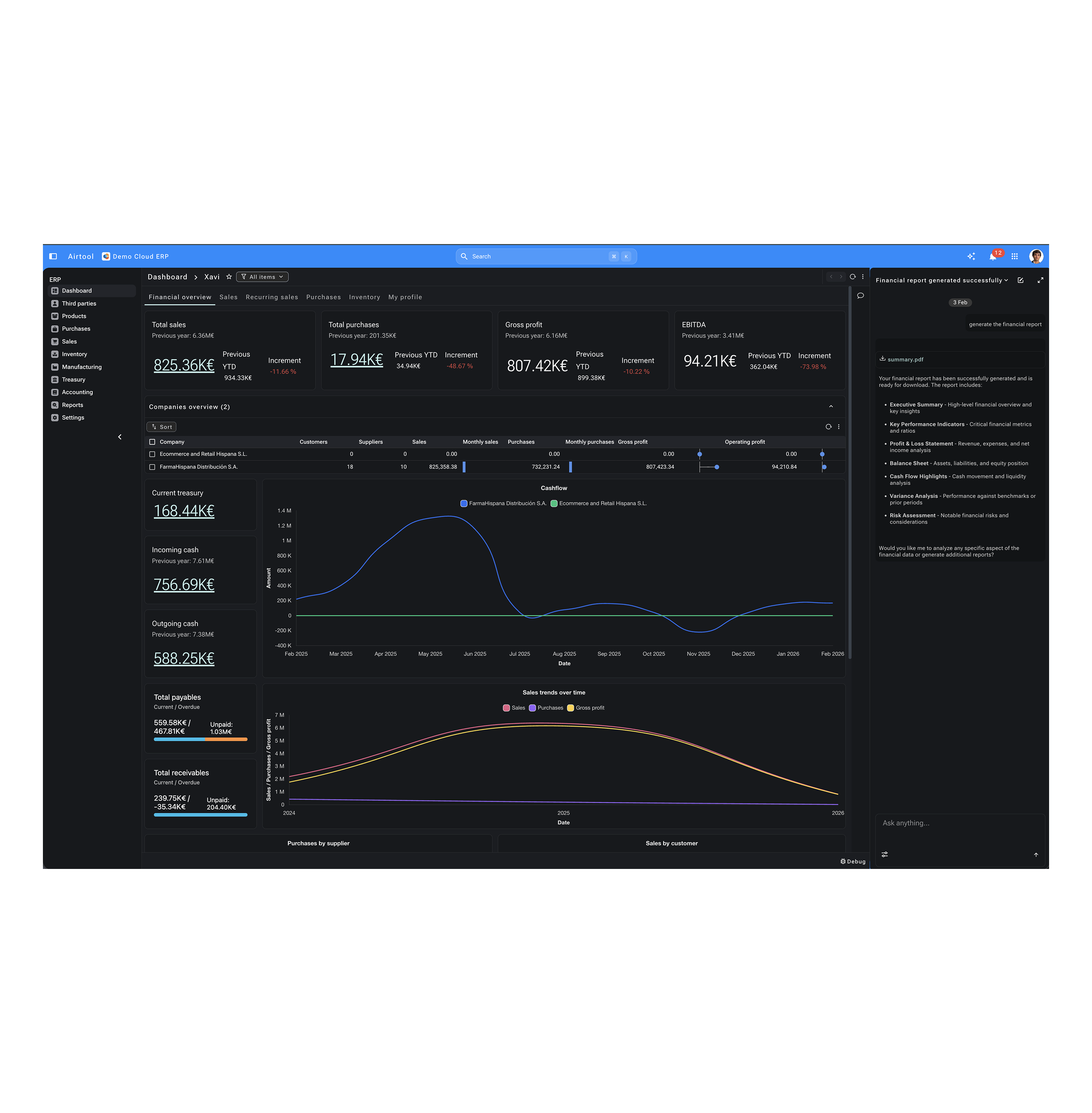
Conversational AI
Enterprise Systems Through Natural Language
Airtool enables conversational interaction with enterprise systems, allowing users to query operational data, generate reports, retrieve documentation, trigger workflows, and access contextual knowledge under strict application-level permission governance controls.

Query live operational data
Generate governed enterprise reports
Trigger secure workflow actions

Operational Data Queries
Ask natural language questions against live governed enterprise data.

Workflow Execution Control
Trigger workflows securely within permission and audit boundaries.

Context-Aware Knowledge Access
Retrieve documentation and system insights within authorization scope.
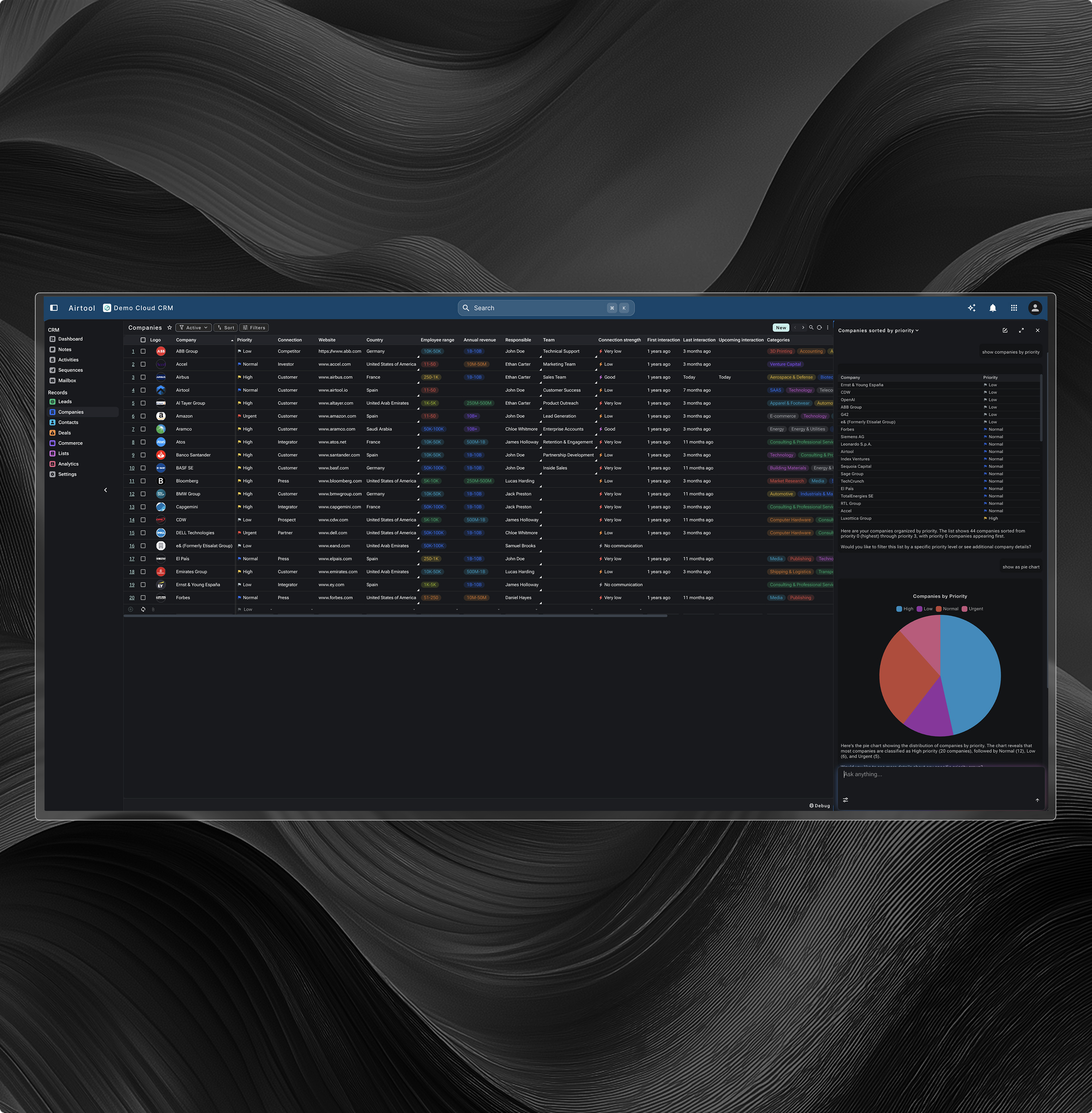
Governed Queries
Natural Language to Controlled SQL
Airtool provides a natural-language-to-database capability operating within controlled schema boundaries, discovering metadata, understanding relationships, generating optimized SQL, enforcing permission checks before execution, and rendering governed results inside the enterprise runtime.
Automatic metadata discovery engine
Relationship and constraint awareness
Permission enforcement before execution
Runtime rendering within platform
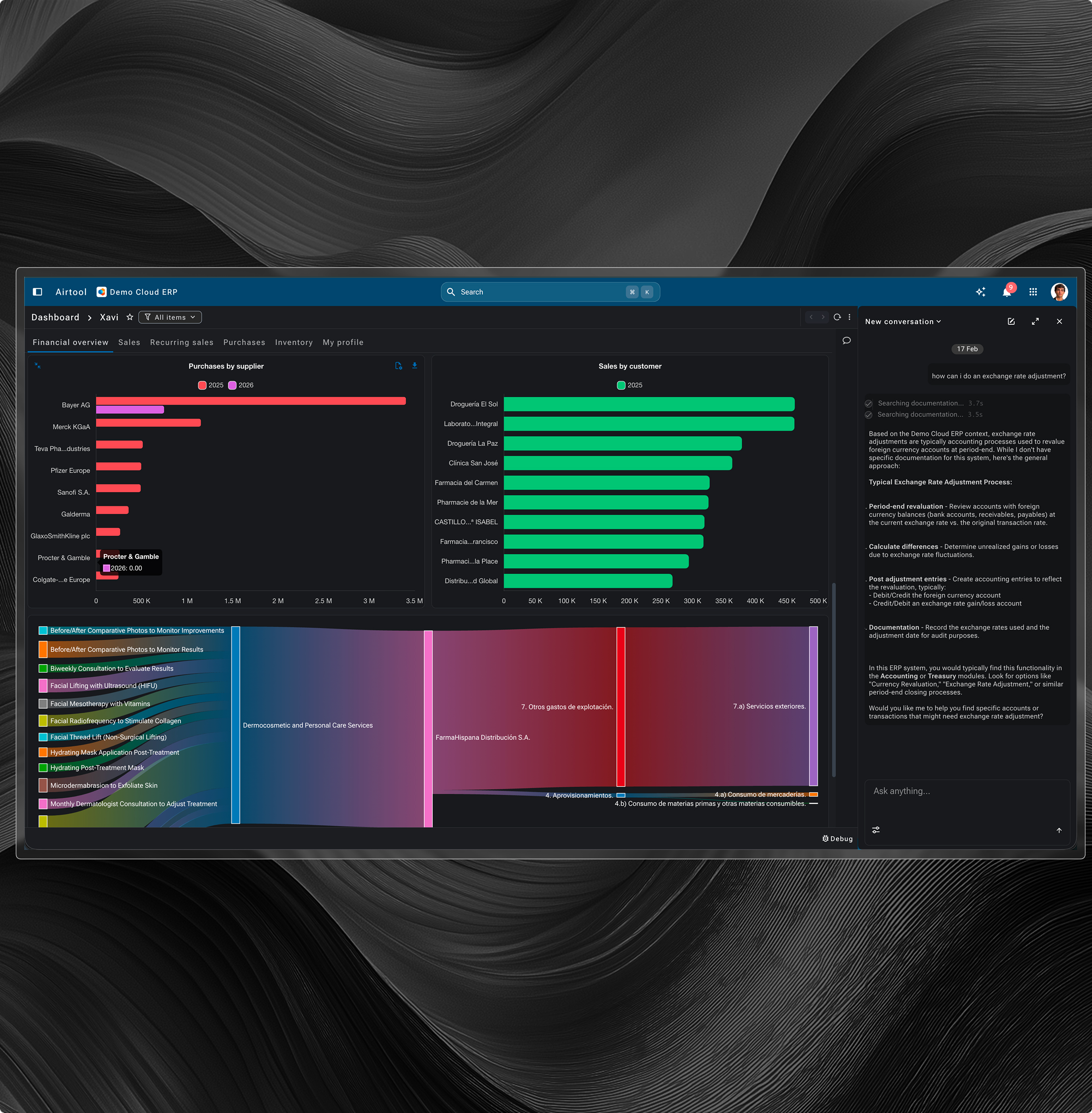
Contextual Knowledge
Retrieval-Augmented Knowledge Within Governance
Airtool supports contextual knowledge retrieval across application documentation, internal system manuals, technical specifications, and business knowledge bases, delivering responses with source attribution, direct references, and embedded contextual links.
Application documentation contextual search
Internal manuals structured retrieval
Technical specification knowledge access
Traceable responses with attribution
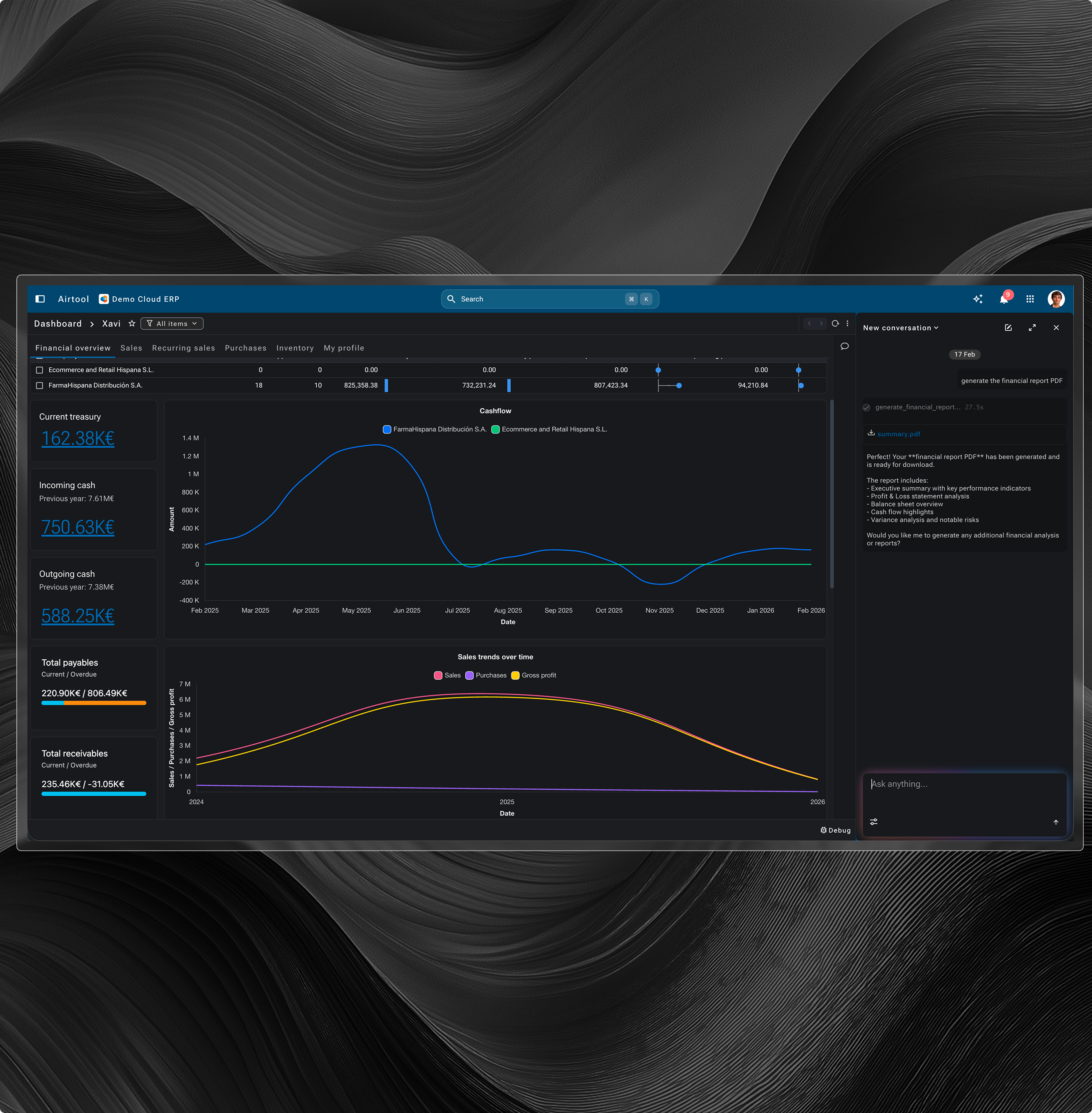
Business Agents
Domain-Specific AI Operational Agents
Organizations can define AI agents tailored to specific operational domains, including financial reporting assistants, inventory optimization agents, billing anomaly detection, and customer analytics assistants — all governed by enterprise data access rules.
Financial reporting automation agents
Inventory optimization intelligence models
Inventory optimization intelligence models
Customer analytics decision support
Model Abstraction
Vendor-Agnostic LLM Integration Layer
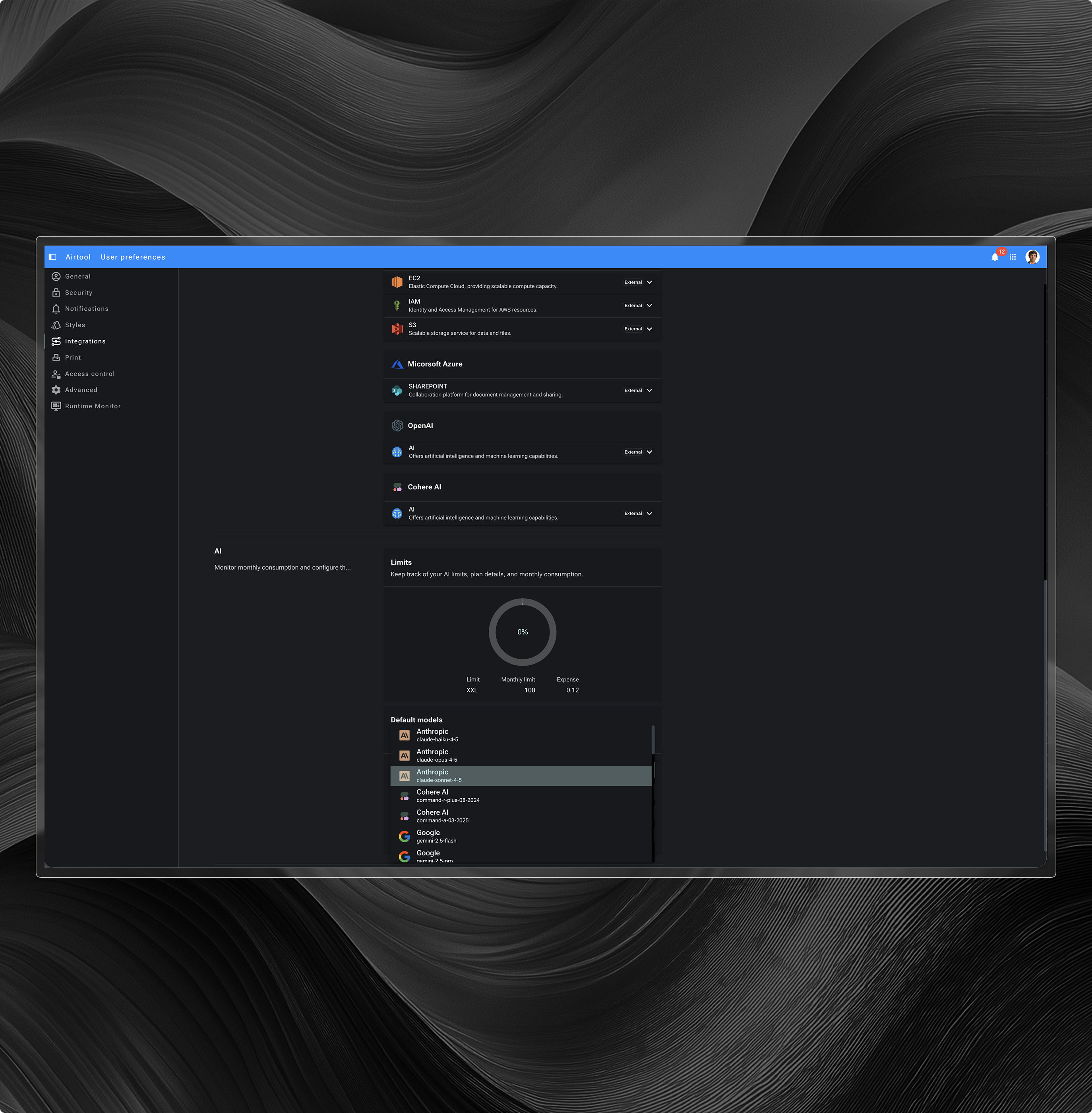
Airtool includes an abstraction layer supporting multiple AI providers, preventing vendor lock-in and allowing organizations to adapt AI strategy over time without rewriting application logic or redesigning enterprise workflows.
Support for multiple AI providers
No application logic rewrites required
Flexible AI strategy over time
Avoid vendor lock-in dependency
AI Governance
Measured and Accountable AI Usage
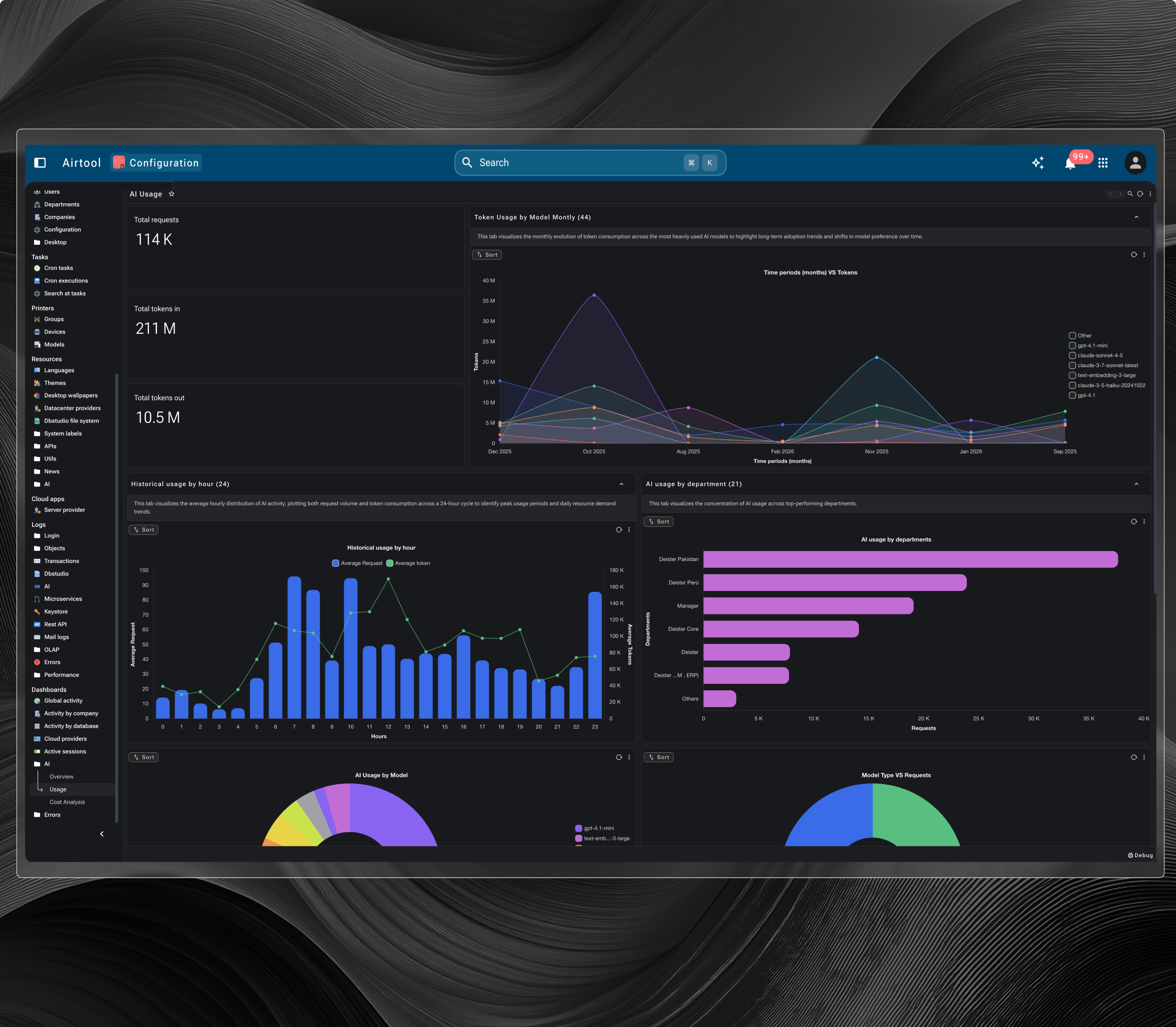
AI operations inside Airtool are measurable and governed. The platform tracks token usage, session activity, and organizational consumption, enabling defined limits, credit allocation, and controlled budget enforcement.
Input and output token tracking
Session and departmental consumption visibility
Organization-level quota enforcement controls
Budget limits and alert thresholds
.jpg)
Embedded AI
AI Inside Operational Workflows
AI capabilities extend beyond chat interfaces and operate directly within enterprise workflows. Intelligence can be embedded into transactions, validation processes, and reporting — all governed by runtime permissions and audit controls.
Transaction validation with AI
Data enrichment during processing
Anomaly detection in workflows
Automated decision support generation
Eliminate AI Risk Surfaces
Enterprise AI Without Shadow Systems
Traditional AI

Uncontrolled Data Exposure
AI tools access sensitive data without unified governance enforcement controls.
External API Sprawl
Multiple integrations create fragmented architecture and unmanaged dependencies.
Inconsistent Permission Enforcement
Access rules differ between applications, analytics, and AI layers.
Cost Unpredictability at Scale
Token usage grows without visibility, limits, or structured budget control.
Fragmented Governance Models
Security, audit, and monitoring operate across disconnected systems.
Airtool AI

Governed Runtime Integration
AI operates inside the same controlled enterprise execution engine.
Unified Security Enforcement
Role-based access and data permissions applied consistently everywhere.
Transparent Cost Management
Token consumption tracked, measured, and governed centrally.
Controlled AI Adoption
AI usage remains predictable, accountable, and operationally safe.
Traceable Decision Support
All AI interactions logged with full audit visibility.
Responsible AI
Designed for Responsible AI Adoption
Adopt AI securely without compromising enterprise governance.

Governed AI Integration
Airtool embeds AI directly into the enterprise runtime, ensuring security, compliance, cost governance, and operational stability remain enforced automatically.
Security and compliance enforced
Centralized cost governance controls
Stable operational runtime foundation

Enterprise-Grade Control
AI operates inside the same governed architecture as applications, eliminating shadow systems and ensuring responsible, predictable enterprise adoption at scale.
No external experiment layers
Unified governance enforcement model
Predictable, accountable AI operations
Enterprise AI Foundation
Adopt AI Without Losing Control
Integrate artificial intelligence directly into your governed enterprise runtime. Operate securely, measure usage precisely, and evolve responsibly without shadow systems or fragmented AI services.
.png)