Customers, sales, operations — one unified system.
Pipeline, accounts, support and revenue analytics in a single governed environment. No integration tax. No data silos. Every capability inherited from the same supervised platform that runs every Airtool application.

One governed environment
Pipeline, accounts, support and revenue analytics share the same records. No middleware. No reconciliation jobs. No which-system-is-authoritative debates.
Same data, no silos
A lead becomes an opportunity becomes an account becomes a support case becomes a renewal — all in the same metadata repository, with the same identifiers, the same security perimeter.
AI inside your perimeter
The AI layer summarises accounts, drafts follow-ups and flags at-risk deals — under the same access controls a sales rep operates under. Every suggestion is auditable.
Built on the supervised platform
Multi-tenancy, audit, row and column security, observability — none of this is CRM code. It is the platform underneath every screen and every report.
Track every opportunity from first touch to closed-won.
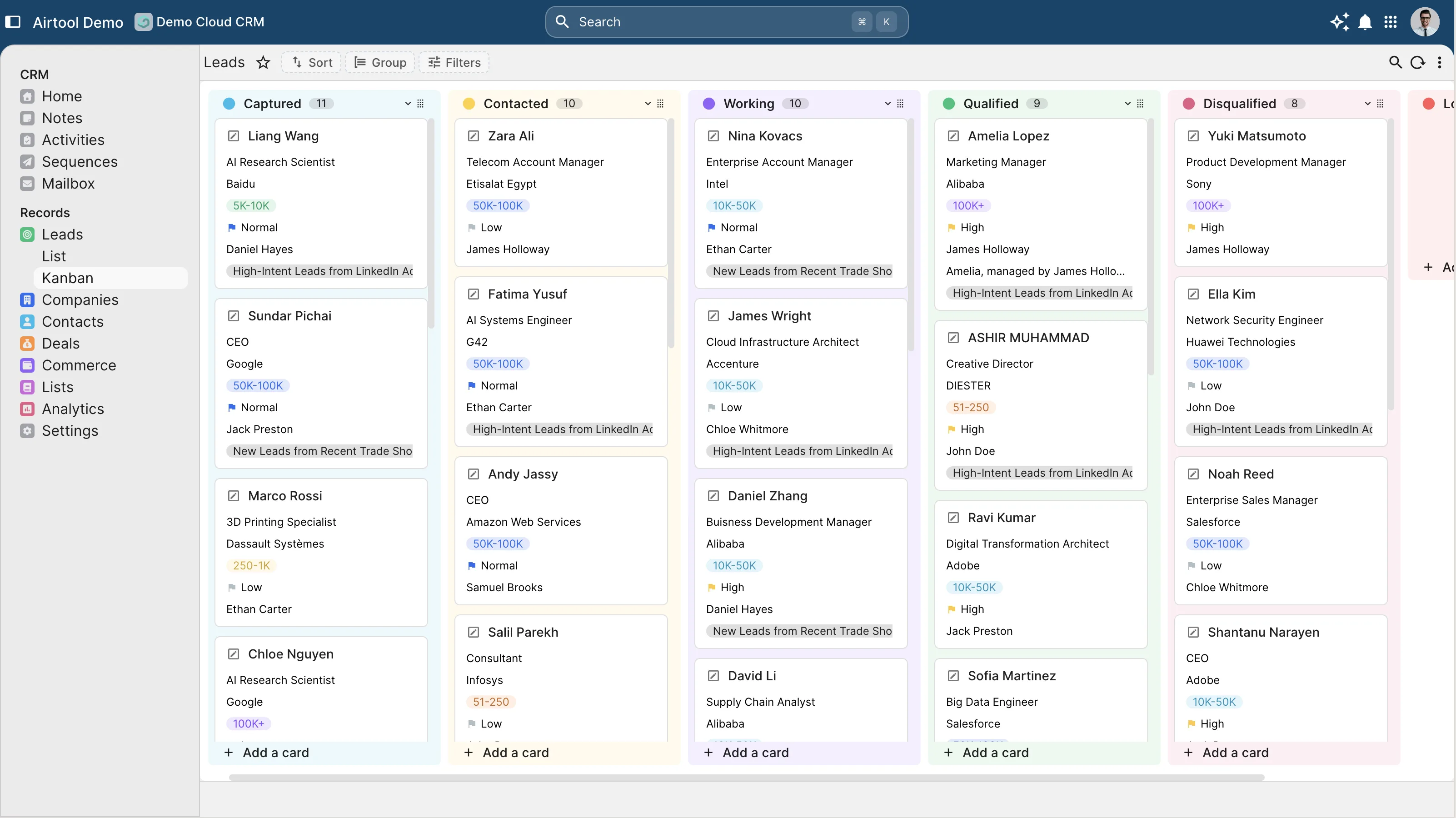
Configurable stages with weighted forecast contribution per stage. The pipeline reflects the way the business actually sells, not a vendor template. Activity, firmographic and behavioural signals combined into a per-lead score. Tunable weights; the scoring rule is a metadata entry, not a vendor secret. Detect and merge duplicates across leads and contacts. Configurable match rules; merge preserves history on both sides. Average stage duration, drop-off analysis, win-rate cohorts. The report is live SQL against the operational data, not a delayed BI extract.
- Customisable pipeline stages — Configurable stages with weighted forecast contribution per stage. The pipeline reflects the way the business actually sells, not a vendor template.
- Lead scoring model — Activity, firmographic and behavioural signals combined into a per-lead score. Tunable weights; the scoring rule is a metadata entry, not a vendor secret.
- Duplicate detection and merge — Detect and merge duplicates across leads and contacts. Configurable match rules; merge preserves history on both sides.
- Pipeline velocity report — Average stage duration, drop-off analysis, win-rate cohorts. The report is live SQL against the operational data, not a delayed BI extract.
A full relationship picture for every account.
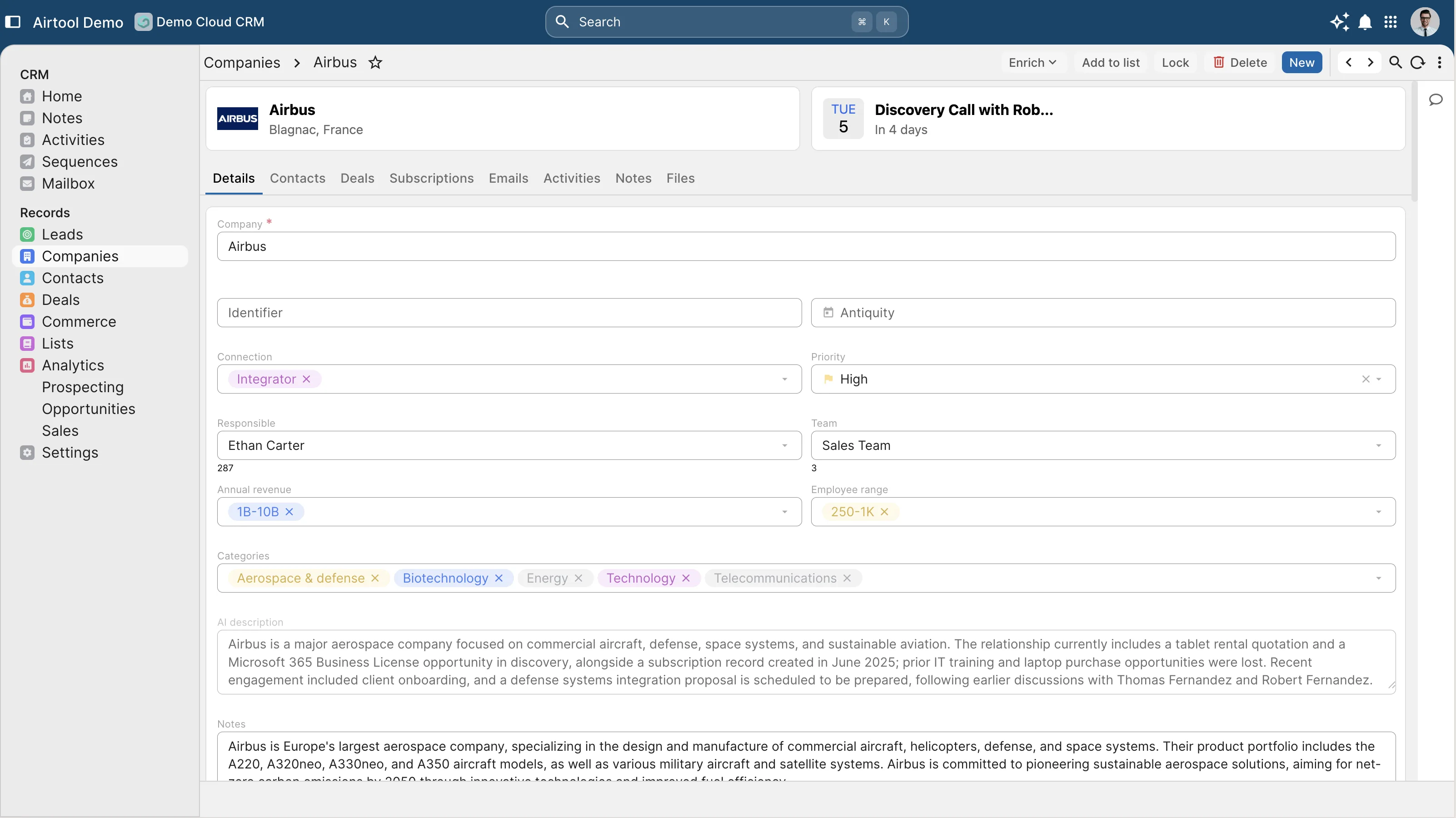
Parent, subsidiary, division and site relationships modelled in the metadata repository. The hierarchy is queryable; rolled-up revenue, exposure and case counts are one query. Every email, call, meeting, order, support case and document, in chronological order, against the account. No tab-switching across systems. A composite score from product usage, support volume, payment behaviour and engagement. Health changes propagate to renewal alerts automatically. Contract end dates and upsell signals drive a managed queue of account-level actions. The same workflow engine the rest of the platform runs on.
- Hierarchical account structure — Parent, subsidiary, division and site relationships modelled in the metadata repository. The hierarchy is queryable; rolled-up revenue, exposure and case counts are one query.
- 360° relationship timeline — Every email, call, meeting, order, support case and document, in chronological order, against the account. No tab-switching across systems.
- Account health score — A composite score from product usage, support volume, payment behaviour and engagement. Health changes propagate to renewal alerts automatically.
- Renewal and upsell flagging — Contract end dates and upsell signals drive a managed queue of account-level actions. The same workflow engine the rest of the platform runs on.
Automate the admin. Keep the human touch.
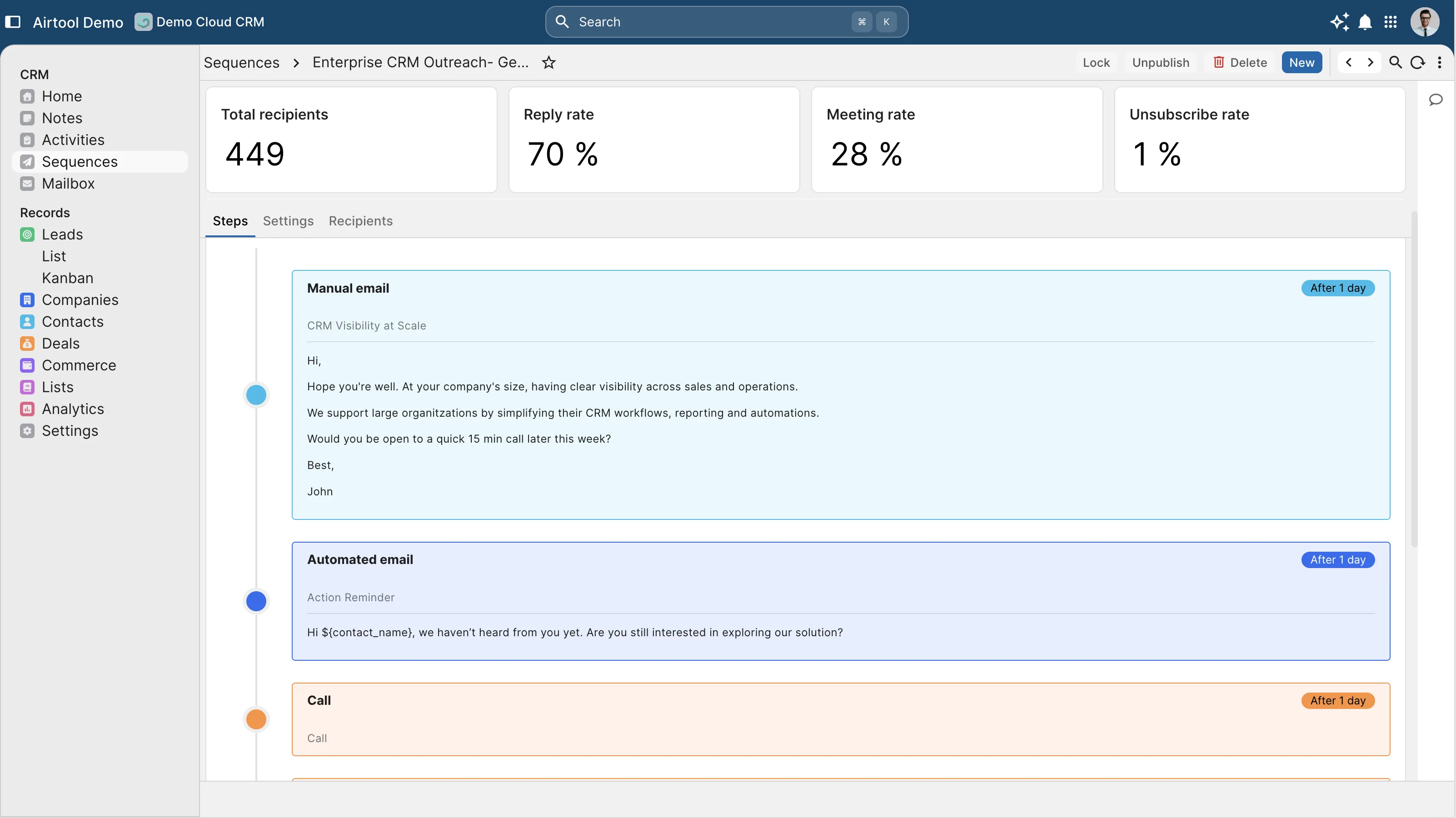
Multi-step sequences across email, call and task channels. Each step is a metadata-repository row; the team edits the playbook without engineering. A library of templates with merge fields against the CRM data model. Send-time personalisation; per-rep variants tracked centrally. Tasks generated from rules — new lead in segment X, opportunity stuck at stage Y, account inactive for Z days. Assignment respects role hierarchy and territory rules. Calendar booking pages per rep, with availability scoped to the user's connected calendar. Meetings logged automatically to the contact and opportunity.
- Configurable outreach sequences — Multi-step sequences across email, call and task channels. Each step is a metadata-repository row; the team edits the playbook without engineering.
- Email templates and merge fields — A library of templates with merge fields against the CRM data model. Send-time personalisation; per-rep variants tracked centrally.
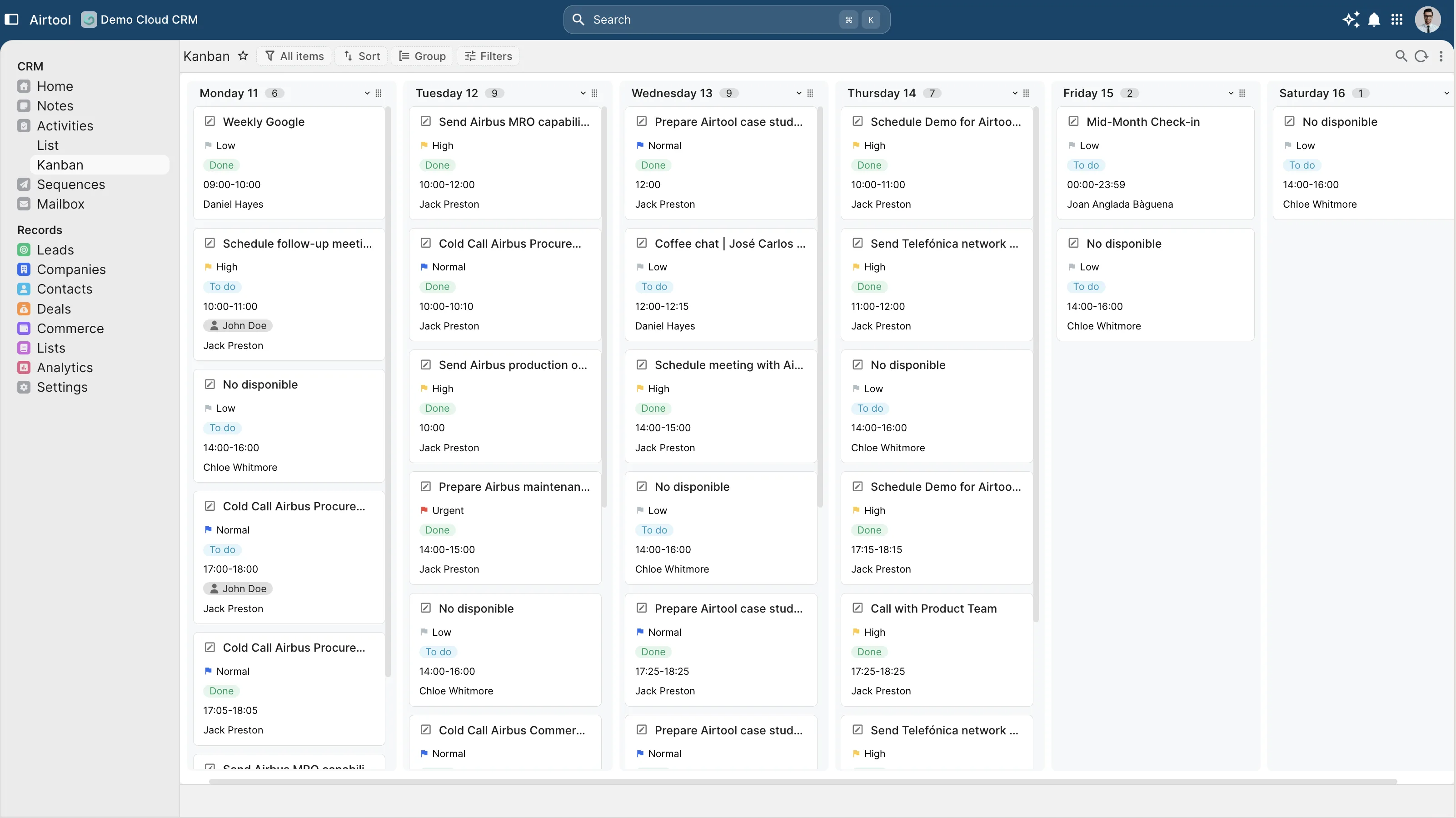
- Automated task assignment — Tasks generated from rules — new lead in segment X, opportunity stuck at stage Y, account inactive for Z days. Assignment respects role hierarchy and territory rules.
- Meeting scheduler integration — Calendar booking pages per rep, with availability scoped to the user's connected calendar. Meetings logged automatically to the contact and opportunity.
Case management with full commercial context.
Cases created from email, web form, phone log or API. Routing rules against queue, territory, product and SLA tier. Every case carries the customer's commercial context with it. Response and resolution SLAs configured per product, customer tier and severity. Timers visible on the case; breach escalations automatic. An internal knowledge base, retrievable via natural language inside the agent console. Retrieval-augmented generation lives inside the platform's permission perimeter. Single-question CSAT issued on case close. Responses linked to the agent, the queue and the customer record for ongoing trend analysis.
- Case creation and routing — Cases created from email, web form, phone log or API. Routing rules against queue, territory, product and SLA tier. Every case carries the customer's commercial context with it.
- SLA policy enforcement — Response and resolution SLAs configured per product, customer tier and severity. Timers visible on the case; breach escalations automatic.
- Knowledge base with RAG search — An internal knowledge base, retrievable via natural language inside the agent console. Retrieval-augmented generation lives inside the platform's permission perimeter.
- Post-resolution CSAT survey — Single-question CSAT issued on case close. Responses linked to the agent, the queue and the customer record for ongoing trend analysis.
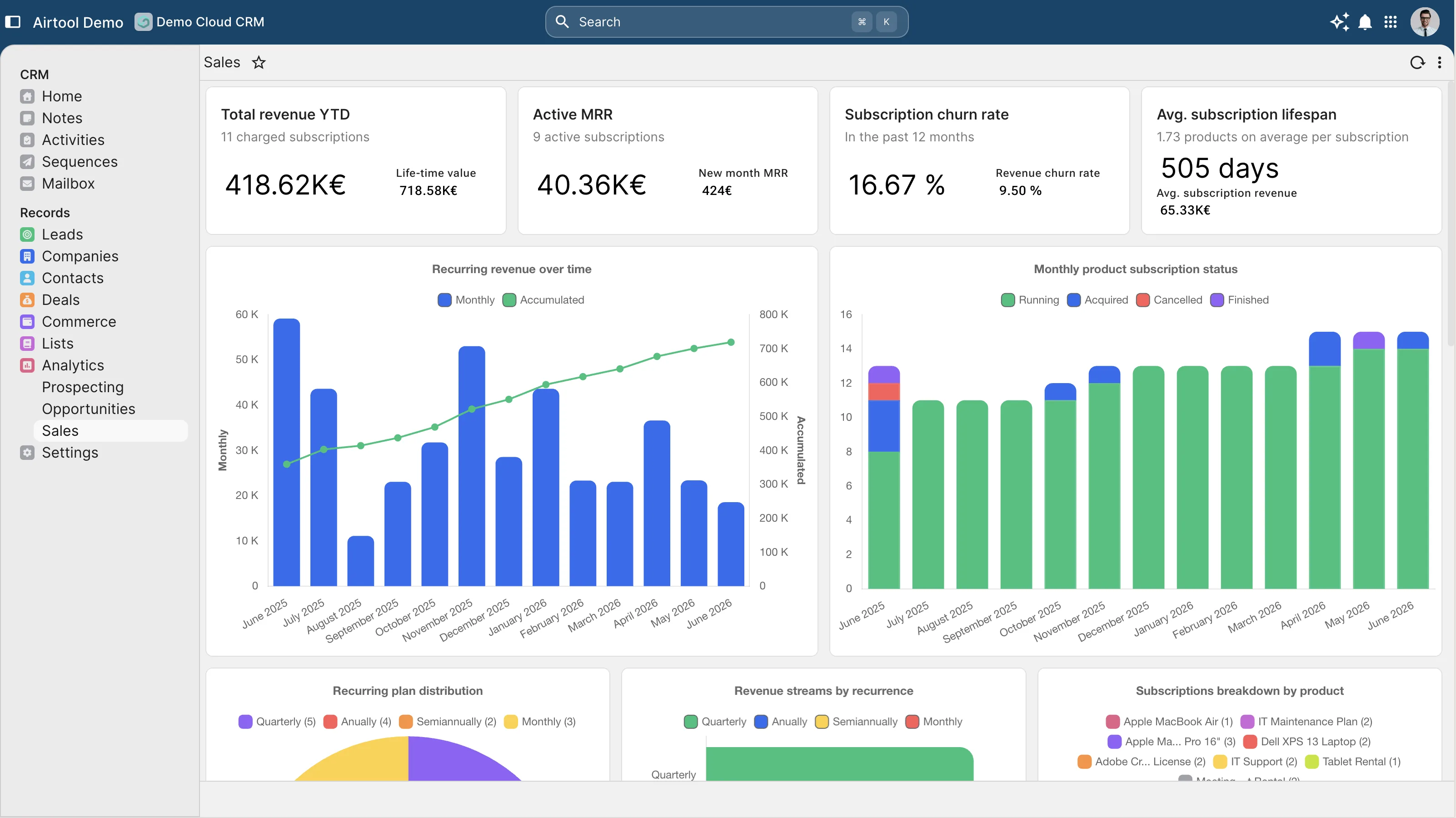
Revenue intelligence that needs no export.
Reason codes captured at closure, analysed by segment, competitor, deal size and time. Findings feed back into the playbook the team is using. Per-rep, per-team and per-region attainment, with linear-pace, weighted-pipeline and probability-adjusted views side by side. Acquired-quarter cohorts tracked through retention, expansion and contraction. New-business vs renewal vs upsell separable in every view. Forecast vs actual at the rep, team and quarter level. Drift visible early; coaching conversations grounded in measured behaviour, not gut feel.
- Win/loss breakdown — Reason codes captured at closure, analysed by segment, competitor, deal size and time. Findings feed back into the playbook the team is using.
- Quota attainment dashboard — Per-rep, per-team and per-region attainment, with linear-pace, weighted-pipeline and probability-adjusted views side by side.
- Cohort revenue analysis — Acquired-quarter cohorts tracked through retention, expansion and contraction. New-business vs renewal vs upsell separable in every view.
- Forecast accuracy report — Forecast vs actual at the rep, team and quarter level. Drift visible early; coaching conversations grounded in measured behaviour, not gut feel.
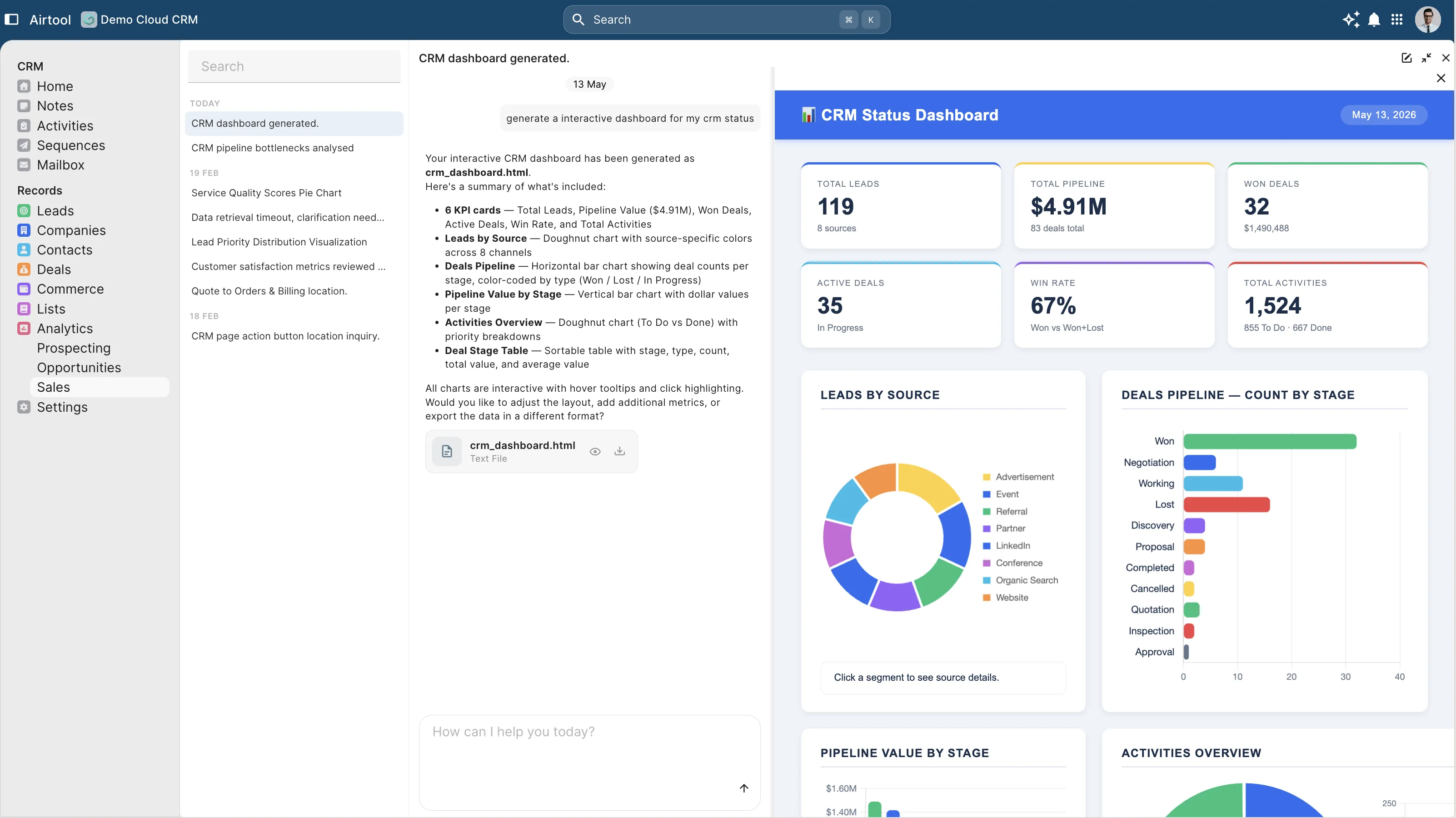
AI that works within your data perimeter.
The AI layer reads the deal's activity pattern, response cadence and stage age to flag the deals most likely to slip. The score is explainable; the rule is auditable. Drafts grounded in the contact's history, the deal's stage and the playbook the team is using. The rep reviews and sends; the AI never sends autonomously. A one-paragraph snapshot of the account's commercial state — last touch, open opportunities, recent issues, health trend. Inside the rep's permission perimeter; nothing leaks out. Suggestions surfaced to the rep based on the account's data and the team's win patterns. The rep chooses; the AI explains the reasoning.
- Deal risk scoring — The AI layer reads the deal's activity pattern, response cadence and stage age to flag the deals most likely to slip. The score is explainable; the rule is auditable.
- AI-drafted follow-up emails — Drafts grounded in the contact's history, the deal's stage and the playbook the team is using. The rep reviews and sends; the AI never sends autonomously.
- Account summary generation — A one-paragraph snapshot of the account's commercial state — last touch, open opportunities, recent issues, health trend. Inside the rep's permission perimeter; nothing leaks out.
- Next-best-action suggestions — Suggestions surfaced to the rep based on the account's data and the team's win patterns. The rep chooses; the AI explains the reasoning.
Every CRM capability above is a platform inheritance.
Multi-tenancy, audit trail, row and column security, AI inside the user's permission perimeter, observability as SQL — none of this is CRM-specific code. It comes from the supervised runtime underneath every Airtool application. The CRM team writes business logic and metadata; the platform delivers the enterprise capabilities for free.
The practical implication for the buyer : a customer building custom CRM extensions on top of Airtool inherits the same enterprise plumbing. A customer using Airtool CRM as a reference architecture and rebuilding their own commercial system on the platform inherits the same. The CRM is a working demonstration of what the platform produces — and a working starting point for what the customer can extend or replace.