ModernisationReplace Informix 4GL, Oracle Forms, Delphi, PowerBuilder, IBM i (AS/400) or custom J2EE on Airtool — schema-first, incremental cut-over, business runs through migration.Read the methodology
Está viendo la edición Perú. Está viendo la edición Colombia. You're viewing the Pakistan edition. Cambiar a la edición global →Cambiar a la edición global →Switch to the global edition →
Modernisation · From Informix 4GL & Genero

Modernise the Informix estate without rewriting the 4GL.

There are three routes off Informix 4GL and the same engineering team builds all three : compile the 4GL into readable Java your developers own ; run the .4gl as itself, as a first-class GraalVM language ; or run it here, on an enterprise application server that executes 4GL under GraalVM on your connection and inside your transaction — and generates the browser interface the 4GL never had. The schema stays. The SPL stays. The rules are never re-derived.

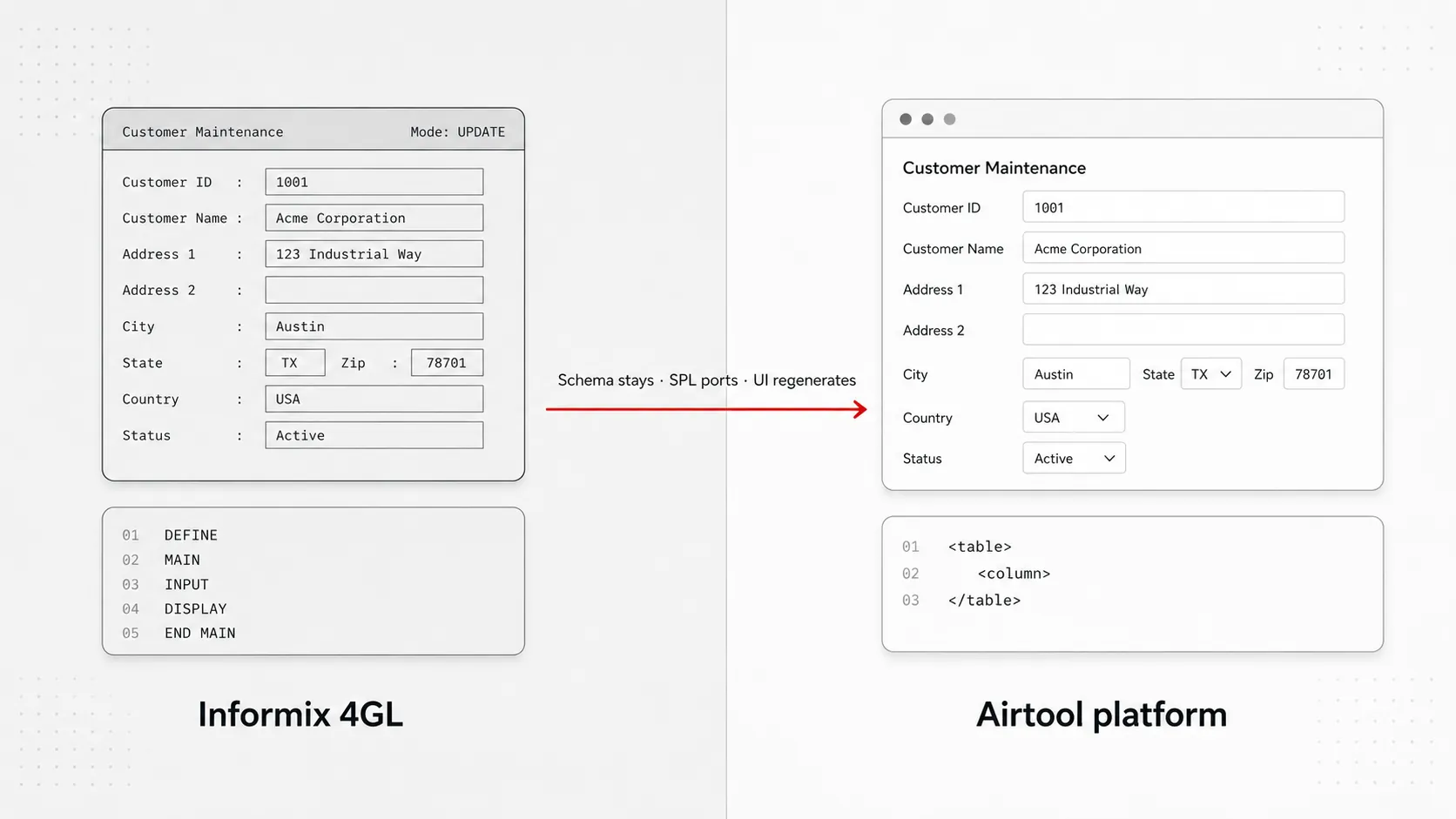
A split-screen before/after diagram. Left: a legacy Informix 4GL Customer Maintenance form with terminal-style field layout and a 4GL code snippet (DEFINE · MAIN · INPUT · DISPLAY · END MAIN). Right: the same Customer Maintenance form rendered as a modern web UI on the Airtool platform, with an XDBL XML fragment. A red transformation arrow crosses the middle labelled: schema stays, SPL ports, UI regenerates.

4GL is a first-class language on this runtime

Server-side execution is a GraalVM polyglot runtime, and Informix 4GL is implemented on Truffle as a language of its own — a peer of the JavaScript, Python and Groovy beside it, in one process and one heap, compiled to native instructions by the same compiler that optimises everything else. The 4GL that runs in production is the 4GL under version control : no transpilation step, no generated code to maintain alongside the original.

The schema stays

The Informix schema is imported as-is. Tables, indexes, constraints, full-text indexes, sequences. No re-modelling. No translation. The reference data model continues to be the reference data model.

The SPL stays

Stored procedures, triggers, user-defined routines stay in the database tier. SPL is preserved, modernised in place, never re-platformed into Java imperative code. Three decades of accumulated business logic is preserved as a native asset, not as a translation risk.

The screens become metadata

4GL is structurally a terminal language — the character screen is in the language, not in the styling — so the interface is the one thing that genuinely has to be rebuilt. Form definitions, menu structures, field validations and report layouts are imported as metadata rows, and the runtime materialises a responsive browser surface from them. Zero hand-written screen code.

Three routes off Informix 4GL. The same engineering team builds all three.

They are not competing products, they are a ladder — and an estate can stop on any rung. The first two are the Informix engineering surface at ifxtools.com ; the third is this platform.

1 · Compile 4GL to Java2 · Run 4GL on GraalVM3 · Run 4GL on the Airtool platform
What happens to the sourceTranslated once, mechanically, into Java — same function names, same comments, same module structure, written to survive review by a developer who has never seen 4GLNothing. The .4gl is the artifact — parsed and lowered to executable nodes by the same front end, then compiled to machine code once a routine is hot✓ Nothing. The same language implementation, embedded in a supervised enterprise application server rather than one you assemble
What you deployA Maven project your team builds and owns, packaged as one versioned jar with its entry point and runtimeOne jar on the classpath of a host that already evaluates scripting languages✓ Nothing to assemble — the platform is the host. 4GL executes on the caller's lent connection, inside the caller's transaction and pool
Where it runsAny JVM in your estate, with your connection pool, transaction manager, identity provider and monitoringInside your own JVM host process, in one heap beside Java and JavaScript✓ On the platform runtime, under its security perimeter, its audit trail and its observability, beside the JavaScript and Python that call it
The interfaceA decision taken later, one screen at a timeStatements that need a character terminal are refused by name rather than emulated in a browser frame✓ Generated. The forms, menus, validations and reports become metadata rows and the runtime materialises a responsive browser surface from them
The data estateInformix stays. No data migration, no schema rewriteInformix stays. The catalogue is read from the connection the host lends✓ Informix stays as the OLTP tier — and stops being the boundary of what a query can reach. Vertica, ClickHouse and BigQuery connect directly for the analytical tier, and federated SQL joins across any connected database in one statement, each connection under the caller's own permissions on it
Best whenThe goal is a Java codebase the team maintains by hand, and owning the result matters more than keeping the 4GLThe rules are the asset, the estate keeps its 4GL engineers, and an existing application server is the destination✓ The whole application has to become current — interface, integration, analytics, AI — and the business rules should not have to move to get there

The five-layer methodology, applied to Informix 4GL

From the schema outward. Each layer is independently deliverable. Cut-over is incremental.

1 · Schema

Informix tables, indexes, sequences, constraints, full-text indexes — imported into the metadata repository's table-object catalogue. Type mappings are applied automatically. Foreign keys, defaults, check constraints become rows the platform can recompile against the same Informix engine or against any of the platform's other target engines, when the workload calls for it.

2 · SPL and triggers

The schema-code processor imports user-defined routines, stored procedures, triggers and built-in extensions in the order their dependencies require. Per-object timestamps track change history. Cross-include resolution preserves the existing modular structure. Performance characteristics carry forward.

3 · 4GL forms become metadata

4GL form definitions, menu hierarchies, field validations, lookups, report layouts and screen-level business rules are read and reified as rows in the Metadata Repository. The runtime materialises the application surface from those rows. The development effort that once produced thousands of 4GL screens reduces to metadata maintenance.

4 · Batch and middle tier

A GraalVM polyglot runtime, so this layer is a choice rather than a rewrite. Existing 4GL business logic — pricing, credit, despatch, period close — executes as 4GL on Truffle, as a peer language in the same process, on the connection the caller lends it and inside the caller's transaction. New work is written in server-side JavaScript or Python with the platform's standard library, against the same data, in the same transaction. Nothing forces a correct rule to be re-expressed in order to modernise the system around it.

5 · UI

Generated from the metadata, on Vue 3.5 / Vuetify 4. The character-mode or thin-client 4GL screens become responsive browser UI without per-screen development. Mobile delivery, role-aware rendering and accessibility are properties of the runtime, not features to be added.

What changes for the operator

The Informix estate keeps doing what it does well — high-throughput OLTP with the data metadata repository you already trust. What changes is everything above the database: the application tier becomes a metadata description that the platform interprets at runtime, integration becomes a first-class concern handled by the platform's gRPC microservice mesh, and observability becomes a SELECT against in-memory MemDB schemas.

The team that delivers this is a database engineer who knows the Informix estate and a business analyst who knows what the business expects of it. The full-stack developer scarcity that kills most legacy modernisations is not on our critical path.

A typical Informix 4GL migration vs an Airtool migration

A typical migrationAn Airtool migration
Database choiceLocked at project start (usually away from Informix)✓ Not a choice you are forced to make. Informix stays and does the OLTP work; the analytical engines connect directly; federated SQL reaches the rest of the estate in a single statement. Six other OLTP engines remain available if a workload later calls for one.
Schema strategyRe-modelled in the target dialect✓ Imported as-is into the metadata repository
SPL and triggersTranslated into application code✓ Preserved in the database, modernised in place
4GL screensRe-written by hand, one at a time✓ Imported as metadata; UI is generated at runtime
Customer-side teamFull-stack developers, Informix experts, project managers✓ Database engineer + business analyst + our team
Cut-overBig-bang at the end of 24–36 months✓ Incremental, parallel-run, business runs through migration
Performance after go-liveVariable; often degraded vs the Informix baseline✓ Predictable. The OLTP engine you trusted continues to do the work.

Informix 4GL and Genero modernisation options — named alternatives

Four Js Genero WebQuerix LyciaAirtool
ApproachAdd web-browser rendering to the existing Genero / 4GL codebase via the Genero Web FrameworkThin-client web rendering of 4GL / Genero screens without changing the application source✓ 4GL screens become metadata rows and the runtime generates the browser surface from them; the 4GL business logic executes as 4GL on the platform's GraalVM runtime
Existing SPLStays in Informix; 4GL application model unchangedStays in Informix✓ Preserved in the database tier, modernised in place — three decades of SPL stays as a native database asset
4GL screensRendered in a browser by the Genero Web Framework; 4GL source continues to define themRendered in a browser via Querix's web rendering layer; 4GL source unchanged✓ Imported as metadata; zero hand-written screen code after migration
DatabaseInformix staysInformix stays✓ Informix stays as the OLTP tier, and the estate around it becomes reachable: Vertica, ClickHouse and BigQuery connected directly for analytics, federated SQL joining across any connected database in one statement
Developer modelContinue developing in Genero 4GL; no application-model change4GL development continues; Querix renders the result✓ Metadata authoring in the platform's Studio, with 4GL, JavaScript and Python available server-side. The Genero runtime licence goes; the 4GL itself stays by choice rather than by dependency
OutcomeWeb delivery from existing codebase; Genero licence dependency; 4GL model retained; no path to AI-native or off-Informix architectureWeb delivery with minimal change; rendering modernisation only; application model and 4GL dependency unchanged✓ Modern browser UI; AI-native; integration-ready; no Genero licence; SPL preserved; business rules preserved as 4GL; incremental cut-over

Why the Informix estate is worth preserving

Informix is one of the most under-appreciated production databases in the enterprise software market — quietly running mission-critical OLTP for a generation of customers who chose it because it works. The modernisation question is rarely "should we leave Informix?" — it is "how do we modernise the application surface without abandoning the engine that does the work?"

Our answer is the same answer we apply to every source stack: preserve what is valuable, modernise what limits the business. The schema is valuable. The SPL is valuable. The 4GL business rules are valuable — and, since 4GL is a first-class language on this runtime, they are preserved rather than translated. The 4GL screens are the cost, and they are the part that is genuinely rebuilt. The platform generates the interface; the rules keep running; the database keeps running.

The rules do not have to be re-derived to be modernised.

Every conventional Informix 4GL modernisation asks the same thing of an organisation : take twenty or forty years of accumulated business rules, most of which are written down nowhere but the 4GL, express them again in another language, and then prove the new version behaves exactly like the old one. That proof is the expensive part, it is where programmes overrun, and it is a risk taken in exchange for a screen that looks current.

It is avoidable here, and for an architectural reason rather than a clever one. Server-side execution on this platform is a GraalVM polyglot runtime, and Informix 4GL has been implemented on Truffle as a language of its own — parsed, lowered to executable nodes, and compiled to native instructions by the same compiler that optimises everything else in the process. This is a language implementation, not an emulation layer and not a code generator : no .java is produced and javac never runs. A 4GL routine is callable in the same heap as the platform's JavaScript, inside the same request and the same transaction, with its arithmetic intact : a DECIMAL keeps the precision and scale Informix gave it, which is the property a rewrite most often loses quietly.

The database is not the program's to open. A 4GL program executes on the physical connection the platform lends it, so a DECLAREd cursor reads rows the surrounding logic has inserted and not yet committed, a RECORD LIKE takes its members, their order and each member's width and scale from the live catalogue on that connection, and a DATABASE statement is redundant. The program opens nothing of its own and closes nothing it was lent.

So the modernisation splits cleanly. The interface, where 4GL was always weakest — it was designed against a character terminal, and the terminal is in the language rather than in the styling — is replaced by a generated, responsive one ; statements that need a screen are refused by name and line rather than emulated, which is precisely why the interface is rebuilt instead of transported. The business logic, where 4GL is genuinely strong, keeps running. New work goes into JavaScript or Python beside it. Nothing is re-derived, so nothing has to be re-proven.

One front end, two backends, and a platform to run the result.

The three routes are not three products bought from three vendors. They share a single compiler front end : the parsing, the LIKE resolution against the live catalogue and the module linking are done once, and only the last step differs. One backend emits Java. The other lowers the same program to executable nodes on Truffle. Both call the same runtime and the same SQL binder, and the same programs are run through both and compared — line for line for screen output, byte for byte for reports. That shared front end is why an estate can change its mind at any point without changing its source.

The Informix engineering behind the first two rungs is documented at ifxtools.com. 4GL to Java covers the source migration — what the emitted Java reads like, how a directory of modules becomes a Maven project, and what the team builds and debugs afterwards ; the compiler architecture carries the verbatim before-and-after proof. 4GL on GraalVM sets out the execution model — one front end, two backends, a real interpreter rather than hidden code generation — and the backend architecture goes down to how a program is lowered and compiled. The same site documents what keeps an Informix engine current underneath any of the three : vector search, change data capture, fuzzy search and graph queries.

What this platform adds is the rung above. The GraalVM route needs a host — a JVM process that already evaluates other languages, owns a connection pool and a transaction manager, and can lend a connection to a program. Assembling that host is a project in itself, and it still leaves the interface unbuilt. Here it is not a project : the supervised runtime is the host, the 4GL runs under the platform's security perimeter, audit trail and observability, and the browser interface, the integration surface, the analytics and the AI come with it. The estate arrives at a current enterprise application with its business rules never having left the language that expresses them.

For the CEO and the CFO

What the board is actually deciding.

The commercial shape of the programme — what changes, what it asks of the organisation, and where the risk went.

What does this change for the business, and why approve it now rather than later?

Three things change and one deliberately does not. The interface changes : a character-terminal application becomes a responsive browser application that runs on a phone, that a new joiner can use without a fortnight of training, and that a customer or a supplier can safely be given a view of. The reach changes : the operational data stops being trapped behind one application, because the analytical engines connect directly and a single governed query can join across the systems the business already runs. The governance changes : multi-tenancy, row and column security, a mandatory audit trail and full observability become properties of the runtime rather than initiatives to be funded separately. What does not change is the business logic — and that is the argument for approving it now. The accumulated rules are the expensive and risky part of any modernisation ; every year of delay adds more of them, and this is the route that does not touch them.

Does the business keep running while this happens?

Yes, and that is a structural property of the approach rather than a promise about execution. Each of the five layers is independently deliverable, so the programme ships in increments and runs in parallel with the existing application instead of replacing it on a single date. The conventional alternative concentrates every decision into a big-bang cut-over at the end of a twenty-four to thirty-six month programme, and the organisation carries the accumulated risk until the day it goes live. Here the schema is imported first and the existing application keeps using it ; screens move in groups ; the business rules do not move at all. There is no point in the programme at which the organisation depends on a rewrite that has not yet been proven in production.

What does this require from our own people, and will we have to hire?

The customer-side team is a database engineer who knows the Informix estate and a business analyst who knows what the business expects of it, working alongside ours. That is a consequence of the architecture rather than a staffing preference : the screens are generated from metadata instead of hand-written, and the business rules are not rewritten, so the two roles that most modernisation programmes cannot hire enough of — full-stack developers, and 4GL engineers willing to spend three years on a rewrite — are not on the critical path. The engineers who know the 4GL stay valuable precisely because the 4GL stays, which also removes the retention problem that a declared rewrite usually creates the moment it is announced.

What is the largest risk in a programme like this, and where has it gone?

It is the same risk in every conventional Informix 4GL modernisation : twenty or forty years of business rules, most of them documented nowhere but the 4GL, are expressed again in another language, and the new version then has to be proven to behave exactly like the old one. That proof is the expensive part, it is where these programmes overrun, and it is a risk taken in exchange for a screen that looks current. It is absent here because the rules are not re-expressed — 4GL executes as 4GL on the platform runtime, with the decimal arithmetic Informix defined. Nothing is re-derived, so nothing has to be re-proven. What remains are the ordinary delivery risks of any programme, and they surface in increments rather than concentrating at a cut-over date.

How does the performance compare with the Informix baseline?

Predictable. The OLTP engine that has been doing the work continues to do the work — the modernisation re-platforms the application tier, not the database tier, so the throughput characteristics customers chose Informix for are preserved by construction. The variability that surfaces after typical engine-swap migrations is not present.

For the CIO

Options, lock-in and the forward path.

How this sits against the alternatives in the market, and what it does to the portfolio's dependencies.

What application platforms support Informix natively for new development after migrating away from Informix 4GL?

The main options for Informix 4GL modernisation that keep Informix as the database are Four Js Genero web-tier rendering, Querix Lycia, and Airtool. Four Js Genero adds browser delivery to existing Genero source without changing the application model — the 4GL continues to be the development language and Genero remains a runtime dependency. Querix Lycia renders 4GL screens in a browser via a thin-client layer, with the application source unchanged. Airtool separates the two questions that the other options answer together. The interface is rebuilt : the 4GL forms, menus, validations and report layouts are imported as metadata rows and the browser UI is generated from them at runtime, so there is no proprietary rendering runtime and no licence attached to displaying a screen. The business logic is not rebuilt : Informix 4GL is implemented on Truffle as a first-class language on the platform's GraalVM runtime, so the rules keep executing as 4GL. Informix stays as the OLTP target. Airtool is the only one of the three where the 4GL survives as a supported server-side language rather than as a source file a proprietary runtime must keep interpreting.

We are using Genero (Four Js Business Development Suite) on top of IBM Informix and want to move off Genero but keep Informix — what are our options?

The options that keep Informix while removing the Genero dependency are Querix Lycia (a rendering wrapper that keeps the 4GL source but replaces Genero's web engine) and Airtool. Airtool imports the Genero form definitions, menus, validations and report layouts as metadata and generates the browser UI from them, preserves the SPL in the database tier, and runs the 4GL business logic on the platform's GraalVM runtime — so the Genero runtime licence and the Genero application model both go, while the 4GL rules themselves keep running. Querix keeps the 4GL source active under a different proprietary renderer. Both keep Informix as the OLTP database. For estates whose goal is to remove the Genero licence and modernise the application surface in the same programme without re-deriving the business rules, Airtool is the path ; for estates whose goal is web delivery with minimal change to the application codebase, Querix is the lower-disruption option.

Does the modernisation force us off Informix?

No. Informix stays as the OLTP target if the existing operational depth justifies it. The platform's Tier-1 DBA team — IDS, CDC, data blades, Java extensions — continues to operate the engine in place ; only the application tier is modernised. Informix is one of the most under-appreciated production databases in the enterprise market, and customers who chose it because it works are not asked to abandon it as the price of admission.

Our analytical data and several other systems live outside Informix. Do we have to consolidate them to get one view of the business?

No, and consolidation is usually the wrong instinct. Interoperability is a property of the platform rather than a project you fund. Vertica, ClickHouse and BigQuery connect directly as analytical engines with native SQL generation — not generic dialect translation — so the high-throughput aggregation runs on an engine built for it while the transactional record of truth stays in Informix. Beyond that, the platform's federation layer answers a single SQL statement across multiple connected databases : a query that previously meant fetching from one system, fetching from another and joining the results in application code is expressed once and executed through the platform's own connection management, with no federation server and no ETL pipeline in between. The permission model is applied per connection, so a federated query that touches a second database is subject to the caller's rights on that database, not only on the primary. A report can therefore read an Informix order, its analytical history on ClickHouse and a record from a third system in one governed query. Informix stays where it is ; what changes is that it stops being the boundary of what a query can reach.

If a workload later justified moving off Informix, how hard would that be?

It is a configuration decision rather than a rewrite, and it is deliberately not the recommendation. Six other OLTP engines are supported — PostgreSQL, Oracle, DB2, SQL Server, MySQL and SAP HANA — and the same repository metadata recompiles against a different target without re-authoring the application surface, so a modernisation that ships on Informix can lift onto another engine later without touching the application tier. In practice most Informix estates should not : the engine is doing high-throughput OLTP work it is good at, replacing it introduces performance variability that the modernisation itself does not, and the reasons teams historically gave for leaving — reaching the analytical tier, joining across systems, getting a modern interface — are all answered without moving the data. The option exists so that the database is never the thing that blocks a decision. It is not a destination the programme has to be pointed at.

What about Four Js Genero — does the same methodology apply?

Yes. Genero is the modern Informix 4GL successor and the same five-layer methodology applies : the form definitions, menus, validations and report layouts become repository metadata, the SPL stays in the database, and the business logic accumulated under decades of Genero engineering is preserved in place rather than rewritten.

For the CTO and the architecture team

How the 4GL actually runs.

The execution model, the boundary the approach deliberately refuses to cross, and the choice between the two routes.

Can we keep writing Informix 4GL after the migration, or is it frozen at what we have today?

You can keep writing it. 4GL is a supported server-side language on the platform, not a compatibility mode with a shelf life : a program is declared as a 4GL script and executes on the platform's GraalVM runtime alongside the JavaScript and Python beside it, in the same process, the same heap, the same request and the same transaction. Teams typically settle into a split rather than a policy — existing rules stay in 4GL because they are correct and proven, new integration, batch, orchestration and AI work is written in JavaScript or Python because the standard library and the talent pool are there, and both run against the same data under the same security and audit model. Nothing forces a rewrite, and nothing forces the next thing to be written in 4GL either.

What is the difference between compiling 4GL to Java and running 4GL on GraalVM — and which one should we choose?

They differ in what happens to the source, and that is the only question that matters. Compiling to Java translates the 4GL once, mechanically, into Java a developer can read — same function names, same comments, same module structure — packaged as a Maven project your team builds, debugs and owns. From that point the Java is the source and the 4GL is history. Running on GraalVM changes nothing about the source : the .4gl file remains the artifact, parsed and lowered to executable nodes and compiled to machine code once a routine is hot. Choose the Java route when owning a Java codebase is the objective and the team is ready to maintain it by hand. Choose the GraalVM route when the rules are the asset, the estate keeps its 4GL engineers, and the cost of the rewrite buys nothing the business can see. Both share one compiler front end, so the decision is reversible : the same source can be run today and compiled later, or compiled module by module while the rest keeps running. Both routes are documented in depth on the Informix engineering site — 4GL to Java and 4GL on GraalVM.

Do we need to build and operate our own application server to run 4GL on GraalVM?

Not on this platform. The GraalVM route can be embedded in a host you assemble yourself — that is a supported way to use it, and the embedding model is documented at ifxtools.com — but the host is not trivial. It has to evaluate other languages, own a connection pool and a transaction manager, lend a physical connection to a running program, and it still leaves the interface, the integration surface, the analytics and the operational tooling to be built. Airtool is that host, supervised and already assembled : the 4GL executes on the connection the platform lends it, inside the caller's transaction and pool, under the platform's row and column security, its mandatory audit trail and its observability. Adding 4GL to the estate is a configuration decision, not an engineering programme.

What happens to DISPLAY, INPUT and the other screen statements when 4GL runs on the platform?

They are refused by name, with the file and the line, rather than emulated. This is deliberate and it is the honest boundary of the approach : 4GL is structurally a terminal language — the character screen is in the language rather than in the styling — so rendering it in a browser frame produces a terminal in a browser, not a modern interface. The platform does not attempt it. The interface is the one layer that is genuinely rebuilt : form definitions, menu hierarchies, field validations, lookups and report layouts are imported as metadata rows, and the runtime materialises a responsive, role-aware browser surface from them on Vue 3.5 / Vuetify 4. Terminal output from a running program is directed to the server's console monitor and captured with the rest of the runtime's output. What executes on the platform is the business logic, which is where 4GL is strong, and what is generated is the interface, which is where it never was.

For the engineering team

What happens to each asset in the estate.

Schema code, screens, replicas and reporting — asset by asset, what survives and in what form.

What happens to SPL, triggers and user-defined routines?

They stay in the database tier and are modernised in place. The schema-code processor sequences user-defined routines, stored procedures, triggers and built-in extensions in dependency order, with per-object timestamp tracking and cross-include resolution. Three decades of business logic encoded in SPL survives the modernisation intact — not translated into imperative Java, not re-platformed into application code.

How do 4GL forms and menus migrate?

4GL form definitions, menu hierarchies, field validations, lookups, report layouts and screen-level rules are imported and reified as rows in the Metadata Repository. The runtime materialises the application surface from those rows on Vue 3.5 / Vuetify 4 — responsive, role-aware, mobile-ready. The development effort that once produced thousands of 4GL screens reduces to metadata maintenance.

Can we scale reads onto Informix HDR / SDS / RSS secondary replicas without changing application code?

Yes. The platform's data-access layer classifies every query as read or write at compile time and routes read traffic to the configured Informix secondary replicas — HDR primary / secondary, Shared Disk Secondary, Remote Standalone Secondary — automatically and transparently. Routing is a system-configuration choice declared once in the platform's connection topology ; the application does not change a line of code. Adding a replica is a configuration step, not a migration. The same capability applies to PostgreSQL streaming replicas and Oracle Data Guard standbys — read-scaling is a runtime property of the platform, not an application discipline the customer's engineers have to remember.

What about reporting — what do we get versus Informix ACE Reports or our existing report writer?

An enterprise reporting and analytics surface far beyond what ACE Reports — or any 4GL-era report writer — was designed to deliver. The platform integrates three columnar analytical engines (Vertica, ClickHouse, BigQuery) for high-throughput aggregation, with native SQL generation rather than generic dialect translation. Interactive dashboards carry drill-down, drill-across and cross-filtering : click a slice of a pie, every related chart, table and KPI updates against the same governed query. Cubes, dimensions and measures live as repository metadata ; reports compose in the same authoring tool that produces operational screens. PDF, Excel, browser-grid and printable layouts render through the platform's document-processing microservice. Row-level and column-level security applies to every report by construction. PowerBI, Tableau and Looker are the realistic comparators on the interactive-BI dimension — not the 4GL-era reporting tools the Informix estate is currently constrained by.

Related modernisation stacks

The five-layer methodology is the same across source stacks. The port-mapping detail is what differs.

From Oracle Forms

PL/SQL stays in the database tier, Forms triggers reify as repository metadata, the Forms Server and Application Server licences go away. The Oracle database stays — or lifts to PostgreSQL.

From Delphi

VCL forms and DataModules become repository metadata, Pascal business logic moves to stored procedures and triggers, the thick-client install-and-maintain model disappears at cut-over.

From PowerBuilder

DataWindows preserved as metadata, PowerScript moves to the database tier and to server-side JavaScript on the platform runtime, EAServer and two-tier deployment removed.

From custom J2EE

Bespoke Spring / EJB / Struts / JSF frameworks replaced by the metadata-driven runtime. Hand-written SQL, integration contracts and audit history are preserved.

From IBM i (AS/400)

DB2 for i schema imports through native DB2 connectivity, RPG and DDS reify as repository metadata, the 5250 green-screen surface becomes a browser. Stays on DB2 for i — or lifts to PostgreSQL.

Talk to an Informix architect.

Discovery call within 48 hours. Schema audit within four weeks. Pilot migration in one quarter.